Showing posts with label YA. Show all posts

Wednesday, February 19, 2014

Unspeakably Delightful

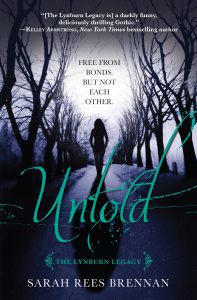
Untold UnspokenThe Cybils brought me to Sarah Rees Brennan, who is probably now my favorite YA author. Her Demon's Lexicon was on the 2009 finalists lists, which was good because I'm fairly sure the cover would never had gotten me to read it (who was that emo-lipped boy? Certainly not Nick). I've since given it as a gift many times, although when I give it to boys I tend to put a slip cover on it. Luckily the soft cover involves swords rather than swooning. I love her characters-- they are funny but real, taking their lives seriously even when their dialogue makes me laugh out loud. Everything feels important and authentic, even when the characters are fighting demon possession or discovering that magic is real and deadly.
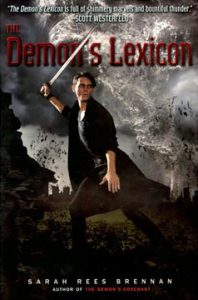

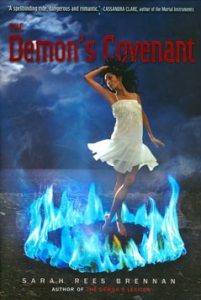
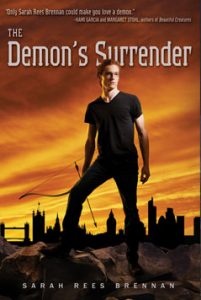
Anyway, I gobbled up her entire Demon's Lexicon series, enjoying the way she took risks with her characters and her story, letting the stakes be real and the dangers sharp, tracing the reality of emotions and identity through her story of magic and possessions. If you haven't read The Demon's Lexicon, The Demon's Covenant, and The Demon's Surrender, go do so. Even if you don't like the covers.

Then she wrote Team Human with Justine Larbalestier, which means I now can hand my friends a book about teen vampire love without cringing. And it means that I discovered a new author.

Her current series is a gothic story about evil sorcerers,  English sheep country, and the dark underside of imaginary friends. The first two are out -- Unspoken and Untold, and they are full of wonderful people, such and Angela, the beautiful girl with the grace of a lion. Wait, I meant the laziness of a lion. Kami Glass, who should teach a detective school with Veronica Mars. Jared and Ash Lynburn, two boys who look alike but react as opposites. Bad guys who sometimes win. Good guys who sometimes do terrible things. Teens who had love lives but still manage to fight evil. Older brothers who protect their sister's friend, for reasons that make sense to both adults and their teenage son, who also loves these books.
And if I haven't convinced you to read them yet (although why not, the kindle editions are only $8), you can try the short story THE TURN OF THE STORY  Brennan has been throwing on her blog as a gift to her readers. Or listen to Mark read the first few bits here.

Sunday, January 26, 2014

Book Sorting -- The Lines Between Kidlit and YA and Adult

I like to read books about kids. That's probably because I like kids, and also because I find some adult issues boring even though they are the main interest of many authors -- adultery, male identity crisis, where to find gorgeous shoes -- these are all things that modern books love to explore but leave me bored out of my gourd. That's probably why I also like genre books -- science fiction, romance, mystery, all these "genres" tend to have something interesting going on, even if they occasionally also throw in worries about who to sleep with, why does no one respect my (male) authority, and shopping.

Sometimes I separate my personal library by kidlit/adult books. (Every five or ten years I like to do a huge overhaul of my books. Doesn't everyone? Don't answer that if you don't at least alphabetize.) And if the protagonist spends most of the time as a child, I sort the book into kidlit because I would have liked it as a child and the author doesn't get a vote. (The Power of One, I'm looking at you.) And I get to decide where YA goes because they are my books. But I'm glad I'm not a public library, because then things get a bit stickier.
Alabama Moon and Awards
I finished Alabama Moon by Watt Key this month, and I'd like to thank past me for putting it on my TBR list; I think it's my favorite book by Key so far. It's the story of the transition into society of the boy Moon, who has been literally raised in the wilderness by his survivalist father. It throws in some crowd-pleasers like the stupid & evil cop (sort of a malicious Roscoe P.) but mainly follows Moon as he struggles to fit in a completely alien society with unknown rules and connections.  Moon is eleven or twelve, and the themes are about connecting to family and trusting in friends, so I'd have no hesitation putting this on my kidlit shelves, but the library has it in YA. Is that because of the guns? The ideas of fearing the government? I have no idea.  I think the publisher is a bit confused as well -- the reading level is ages 9-12 or grades 6-8. Those don't match up, but the complete range (age 9-14) seems right.

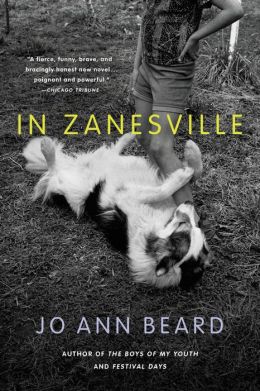
In Zanesville: A NovelI also completed In Zanesville by Jo Ann Beard and while that managed to miss the spot for me I think that was more my problem than the author's. It recreates the adolescent world of a girl in the late seventies/early eighties with fine precision, but it's a world that was alien to me at the time and so I didn't enjoy revisiting it. I wasn't into boys and clothes as a teen, and I found the girls who were dull and sometimes antagonistic, so spending pages in the head of one of them was uncomfortable. It's also a book that seems written to remind people of their youth rather than to resonate with someone living their youth, which is why I guess the library puts it in adult fiction rather than YA despite the teen-age protagonist. On my shelves it would have gone straight in with the kid books, since I would have approached it with a science-fiction style of entering into an alternate reality, but when I was a kid I wouldn't yet have the memory baggage that made it an uncomfortable journey.


Wednesday, March 6, 2013

Some More Best Books

Although the challenge is long over, I'm still working my way through the 2012 Best of the Best ALA lists. Whenever I finish I'll probably start the current years -- it looks like it won't be 2013, though.

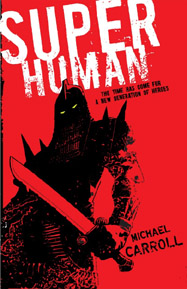
Super Human, Michael Carroll.  This Best of the Best choice took me forever to get to, much to my son's chagrin, since he recommended it highly. In fact, we saw the next two sequels at the bookstore before I even finished this one. My favorite part was the world building, which was done with pleasing subtlety. The details of the super-hero rich world, with both smart inventors and heros with special powers, is revealed through the matter-of-fact actions of the main characters, both super and non. But the very end, where the basic foundations and morality of the society are questioned, throws everything into doubt in a very interesting way. I'm very glad I have the next book waiting for me. (I wrote this last December or so, and I have to admit I haven't yet started the next one, although I know where it is. I am looking forward to it, though.)

Curse of the Wendigo, Rick Yancey. Narrated by Steven Boyer. This horror story was far too grim for us, with the eleven year old dropping out early and even the fourteen year old saying I could listen ahead without him. The dead baby floating in a sea of excrement in the last disc was just the last and worst of a series of really gross scenes that kept throwing me out of the story. It got so that we just hung out waiting for the next icky thing. Nice vocabulary, though. Both boys think I'm insane for insisting on finishing it.

 
Scorpio Races (audio) Maggie Stiefvater.  Narrated by Steve West and Fiona Hardingham. X and I have both read and enjoyed this novel before, and P had fun listening along, although he didn't blink when I listened ahead without him. The dual narration worked very well, which at first I worried about. I could hear where the narrators made some different choices than I had when I read it, but not in an annoying way. Both X and I noticed the love story much more in audio format, although I'm not sure whether that's a rereading thing or an listening thing. Also, I'm a sucker for British accents saying "Sawrn" or "Puck Connolly." This one is highly recommended as a written or audio book.

Thursday, July 26, 2012

Award Winner: Parrot in the Oven

Parrot in the Oven By Victor Martinez Illustrated by Steve Scott Well, I've officially fallen behind in my summer goal; I decided to get to sleep at a reasonable time and then I spent a day driving and didn't finish my assigned book.

I did read some library books that were falling due, but that doesn't count. Phooey. I still hope to catch up this week, and then we'll keep trying.  Today I finished Parrot in the Oven by Victor Martinez, a novel in short stories about a boy growing up in a Mexican American family, struggling with academic ambitions that are left unsupported by his school and peers, an alcoholic father and a generally abusive family, a peer group that values fighting and theft, and the general prejudice of whites against anyone brown or black.

http://www.flickr.com/photos/barockschloss/3569109923/lightbox/
BarockSchloss CC License
Martinez's stories have a delicate flavor to them, wrapping the feelings and senses of the moment carefully up and then leaving quietly so the reader is left alone with the emotions. It was a powerful book that I didn't manage to read quickly enough on the drive home.

Monday, July 23, 2012

Sea Magic: The Changeling Sea

The Changeling SeaPatricia McKillip's books always deliver a combination of magic and emotional truth. This means that I'm not always in the mood to pick them up, since emotions are heavy things, and occasionally she doesn't get the balance just right. The cover of The Changeling Sea also deterred me; it looked like a book about a child and her mentor, and I just never had the urge to start that story. So although I clearly bought this book back in California (it's a discard from the San Mateo County Library, one of a half-dozen libraries I frequented when I lived near San Francisco), I hadn't read it until today.

http://www.flickr.com/photos/barockschloss/3569109923/lightbox/
BarockSchloss CC License
I also took a bit of a chance, leaving this book until the end of the day so that I read it straight through, instead of putting it down when things got tough, my usual cowardly approach. But it paid off; the story wove magic and love and loss together in a lovely enchantment, much as the sea turned Peri's angry hexes into webs of moonlight and beauty. Despite the cover, the protagonist was a young woman, not a child, who starts off struggling with multiple losses, including a mother who retreats from the sadness of the world. As Peri emerges from her grief we also enter into a world of magic and loss and longing, and she encounters love and friendship and greed and danger.

And, just as in McKinley's The Hero and the Crown, she doesn't insist on limiting herself to a single lover; life has tides and changes, and your heart can weather them. It's a wonderful read, although not the one promised by the cover on my copy. (The cover shown isn't the one I got; it's actually a lot more representative.)

I'll leave this around for the boys, although it doesn't really hit any of their obvious buttons.

Saturday, July 14, 2012

More Mythology: Temping Fate

I was actually on a Foolscap panel with Esther Friesner a few years ago, so I made a point of buying Temping Fate from the dealer's room. Of course, I usually come home with a pile of books from Foolscap, so this one ended up piled in the TBR bookcase until today.

http://www.flickr.com/photos/barockschloss/3569109923/lightbox/
Barock Schloss CC License
It's a fun book about people with strange names (Ilana, Dyrrin) interacting with modern versions of ancient gods, mostly Greek through a summer temporary work agency designed to let the deities get a bit of a break. Ilana, who gets a confusingly interesting back story, lands this summer job and wavers between enjoying the high wages and backing away from the magic and danger involved, while fending off the insanity of her sister's extreme wedding plans.
Photo: They call this the "anticlimactic " flaming geyser.
Anticlimatic Flaming Geyser

I didn't finish until late, since we went out to Flaming Geyser state park to celebrate my Discovery Pass. We tracked down the Anticlimactic Flaming Geyser (as the local rangers named it) but read up on its glory days a before my birth when it leaped up much higher. Not content with this, we then went to the local water park for the evening to hit the water. Well, I didn't get far enough in the book to do the laps I actually contemplated, because I had the pleasure of hanging out and talking with my son for a while. I will definitely give this book to my eight grader though; he lives urban fantasy and Greek mythology.

Wednesday, May 30, 2012

April Family Pick: Feynman

Feynman coverFeynman still reigns as the coolest physicist, and the Cybils Graphic Novel finalist and graphic biography Feynman by Jim Ottaviani (art by Leland Myrick, coloring by Hilary Sycamore) helps him maintain that reputation. Starting with his childhood bedtime stories, which emphasize process and understanding over vocabulary (and accuracy), the comics follow present his progress from a stance of smug reminiscing, writing as if Feynman were telling these stories about his education, his wives, and his work.
Cybils2011-Web-ButtonBG

The pictures kept the characters identifiable for me, with Feynman's beaky nose and wavy hair identifying him from high school through the Challenge investigation. Since my weak visual skills often has me scrabbling to identify who is talking in a graphic book, this consistency helped a lot.

P received a copy as his birthday present from his dad, so we made it the April Family Book Club choice, although it took us until almost the end of May to have the meeting.  P actually stalled out in the middle of the book, and I agreed that at age eleven I also would have found the story of Feynman choosing which university department best suited his career dull, and the bits about his girl-chasing and second marriage incomprehensible. So we talked about what age to read things, and then more about his adventures in youth (tricking the guards at the Manhattan Project, finding the bad valve by pretending to read design documents, safe cracking).  We spent a lot of time figuring out the safe cracking parts, in fact.

Overall, we decided it was a good book for YA and up, but only recommend the first half to the elementary crowd. I'm not sure why it's a Graphic "Novel" since it seems to be a nonfiction biography, but then the nursery rhyme book also ended up in this category so clearly I'm missing something.

Saturday, May 12, 2012

Blood Red Road: Mean Sisters

Blood Red RoadI know other people have loved this YA Fantasy Cybils finalist, but not me. I found the characters repellent and useless in Moira Young's Blood Red Road. I'm not sure which sister is more repellent,  Emmi or Saba, although I guess we can hope that Emmi could change as she grows up. Saba is slowly learning to be less awful, but not less self-centered or dependent. The world building also didn't make sense; I dislike books with a single magical artifact which serves only to break the suspension of disbelief -- it's a huge crack in the post-apocalyptic setting.

At the start of the book, Saba is firmly established as an emotionally deficient person, who has resented her baby sister for nine years for causing the death of their mom. No, Saba is not ten or eleven at this point, which would make this stunted psyche palatable; she is eighteen. An eighteen year old who still holds an infant responsible for the death of its mother is not a very likable character. Anyway, we soon see that there are other reasons to dislike Emmi, so maybe I shouldn't judge Saba too harshly.

Cybils2011-Web-ButtonBG
Saba spends the book trying to rescue her beloved twin brother who got kidnapped in the first section. She does this despite the assistance of Emmi, who at nine years old doesn't understand that she is not actually in any way an asset to this expedition. Yes, she can use a sling shot, but she also has no attention span, drops things, and has the stamina of a child, slowing down the more robust adults who are racing against the clock to save her brother. Oh well, at least she offers Saba the chance to grow emotionally, and after all, secondary characters aren't there for themselves but to offer Saba opportunities for growth or interaction. Emmi probably only kills two people with her antics, so not much harm done, right? Saba keeps trying to leave her somewhere safe, and is treated as a monster for not wanting to bring her kid sister into various war-zones.

Saba finds a love interest. We know he is her love interest because a magical doo-dad heats up whenever he is around. Also, he has good abs. Saba insults him horribly by not showering him with complements all the time (all the other characters frown so the reader can't fail to notice what a loser Saba is), but he is heroic enough to forgive her once she starts kissing him. I found their love affair emotionally distasteful, but understandable as a pair of lusty teenagers.

At the end of the book, I'm still wondering how awful was the death of Mercy, the neighbor woman who kindly took in Emmi only for the the girl to steal her horse and leave her injured and alone. At the end, the kids decide not to return to see how she fared, because that would be the decent thing to do, and the entire family avoids decency like the pustulent plague. Maybe the sequel addresses this.

The only thing I liked was the voice -- the sparse sentences and tone helped carry me through the story even when every member of this family accepted the love of strangers while selfishly backstabbing them or stealing their stuff. They are the kind of people that make for good stories, but I'd hate to actually encounter them. Probably the main problem was that Mercy was the person I could most identify with, so even though her part was tiny I never got over how the sisters used and discarded her so casually.

My seventh grader liked it a lot; he thinks people make tough choices in a post-apocalyptic world and I'm judging the girls too harshly. He found the plot fast moving, and that's the mark of a good book. 

Saturday, May 5, 2012

Girl Power: Misfit

Finally I finish another Cybils books, a YA finalist in Science Fiction and Fantasy. Jon Skovron's Misfit disappeared with my seventh grader for a while, and he returned it with a strong recommendation. I didn't find the cover all that appealing though, so I procrastinated on the start and let myself get distracted along the way.

Cybils2011-Web-ButtonBGBut the cover fooled me; it's not misleading, because the book does deal with Catholic fears of demons and exorcisms; Jael's father, an ex-priest, keeps her enrolled in Catholic schools for good reasons, but the story isn't a simple one of priest=good, demon=bad (or vice-versa).  Instead, everyone is an individual and makes individual choices, whether they are human and bound to Earth, demon and bound to another plane, or a half-breed with access to both worlds. And Jael is not just a kid with superpowers, she's an adolescent whose father isn't sure how to know when she is grown up, a motherless child whose father still hasn't figured out how to talk about the wife he lost, a Catholic schoolgirl figuring out what she believes and who she can trust. I liked the variety with which people dealt with faith; some people believed foolishly and shallowly, others with heart and soul, and still others dealt with skepticism and questions.

At the end, the book made me look at the roles of a parent and an almost-grown child, the strengths of love in family and friendship, and the worth of loyalty. It's a book that affirms the important things about being human.

For religion month, this book shows a good variety of beliefs among the characters, from devout Catholics to crazed religious zealots through questioning youths and cynical atheists. But for all of them, religion is a real and powerful force in the world.

Wednesday, May 2, 2012

Growing Up: A Wizard of Mars

Nina and Kit have worked together for years before Diane Duane's A Wizard of Mars starts off. No longer the youngest, hottest wizards, they are moving up in their hierarchy while also worrying about grades in their more difficult high school classes. Nina's dad expects her to keep track of her younger sister, whose grief over their mother's death manifests itself in losing herself on another planet far far away studying star maintenance.

Kit wrangles with his sisters, the one at home shameless borrowing all wizardly perks to help her shop, and the one coming back from college still unsure whether his powers stem from Satanic bonds or not. But he's distracted by the lure of Mars, a research project that calls to him more and more directly. When Mars tests him with a series of projections based on Earth fantasies about the Red Planet, I was very glad that my recent viewing of John Carter helped me keep up. (I had a great time and I recommend the movie if you can still find it somewhere.)

Most of all, both kids are growing up. Everyone has been teasing them about being boyfriend and girlfriend for so long, but would it be so bad? Both approach this delicate question from their own perspective, and Kit gets a bit distracted when a gorgeous Martian princess decides he's her long lost lover. Oh, and also the Earth almost gets destroyed, but that's really just par for the course for these two.

Duane's Young Wizard books (this is the ninth) are fundamentally about real kids who just happen to have their own connection to the magic of the universe. The magic parts seem fuzzy; the books always manage to have the spell to do what needs to be done, but the kid parts are solid, so that the problems they face in the real world help keep their wizardly dilemmas important as well.

Religion in May: Neither kid draws on religious beliefs for strength, although magic involves a good One and the evil Deceiver. Kit's family attends church as a matter of course. So it's not about religion, but it's there positively in the background.

Monday, April 23, 2012

Creepy Dolls: The Many Faces of George Washington


The next Cybils nonfiction finalist I read is The Many Faces of George Washington, by Carla McClafferty. This oversized book looks at the study follows two stories -- the history of George Washington and the attempt by modern historians to make him more relevant for today's Americans. When focus groups were asked to describe George, terms like "frumpy" and "boring" kept repeating, which shocked and horrified true Washington groupies.  To counter this perception, Mount Vernan researchers commission new dioramas that would feature astonishingly lifelike manikins portraying The Father of Our County as a sexy youth, a powerful general, and a dignified president.

Cybils2011-Web-ButtonBGMcClafferty then starts trading off between a traditional biography of Washington and following the creation of the figures matching each period of his life. The illustration show both scenes and souvenirs from his life and the processes used to replicate the clothes, hair, horses, and bone structure of his person at each stage. I found it easy reading, although sometimes the lifelike images seemed rather creepy. I couldn't interest either of the boys in the book though, not even the one forced to write a report on Washington. They couldn't get interested in how a frumpy green guy like Washington was replicated, which seemed like a chicken & egg problem -- the book was about how these dolls make Washington seem more vibrant and interesting, but their preconceptions held them back from finding out that they were wrong.  Also, they are lazy about reading nonfiction.

Sunday, April 22, 2012

Unhappy Families: Northward to the Moon

NorthwardAlthough I know I've read My One Hundred Adventures, Polly Horvath's previous book about Jane and her family, I only remember scattered bits and a feeling of gentle quirkyness. When I browsed the HOR shelf for my Reading My Library quest, I naturally gravitated towards a familiar name. Yet Northward to the Moon left me feeling deeply sad, and I'm not sure that was Horvath's intention in writing the book.

Jane's poet mother, her three siblings, and her newish step-dad Ned have spent the past year far from their Massachusetts beach house. Ned's job in Saskatchewan has the two younger boys imprinting on vast prairies instead of constant waves, leaving Jane to wonder whether this will be a permanent dividing line in her family -- she and Maya imprinted on the ocean while their brothers belong to the land. This early musing indicates a theme of this book, that families break apart and love cannot hold.

The family wanders dazedly from one town to another, following Ned's hatred of the known and secure. Along the way they fail to make connections with his old mentor, then his brother, and then his entire family. His family stages a mini-reunion when his appearance at his mother's ranch triggers a life-long injury, so his sisters can rally around and again fail to connect. Jane slows down the plot for a paint-by-the-numbers unrequited crush on a cute adult, complete with the humiliating realization that her painfully obvious crush has indeed been noticed by everyone over the age of eight. Meanwhile Maya's discomfort at all these disruptions pushes her farther and farther into despair, but no one has time to care. Finally everyone returns to Massachusetts to complete the splintering of the family.

It's told in Jane's authentic and usually vivid descriptions and thoughts (the exception is during the dreary crush), and the beautiful language almost conceals the heartbreak and tragedy piling up on every side. I will not be leaving this book anywhere near my already sad fifth grader, and my seventh grader would refuse it anyway since it's a sequel.

Friday, April 20, 2012

Hard Times: Between Shades of Gray

Between Shades of Gray Book
Cybils2011-Web-ButtonBG
Memories of The Endless Steppe haunted my reading of Cybils Young Adult Fiction finalist Between Shades of Gray, Ruta Sepetys's story of a Lithuanian teenager arrested with her family by the Russian police just as World War II swept across the European continent.  Torn from a rather privileged childhood, Lina and her brother have only their mother to protect them as they are herded into cattle cars and shipped across Russia to a succession of labor camps, each grimmer than the one before.

Sepetys gives Lina a believable voice, from her naive and reckless dedication to her art through her understanding of the dangers they face, both from the bullets and blows of their captors to the slow draining of their souls and selves from the unremitting brutality and deceit. Lina tries various schemes in attempts to reconnect with her father, but the realism in the story prevents any of them from succeeding. The cruelty and sadism of the Russian guards are sadly convincing, as are the appalling conditions at the Arctic camp they end up in. Although there is an epilogue providing a hint that some characters survive, overall the story is as tragic as the time period suggests.

I'll see if my son will try this; he's not much for historical fiction. It would be interesting to see if he understand the context; for example, why some people hope Hitler will save them, or the importance of the Jewish man's concealment of his religion, or what happened to the country of Lithuania at this time. (The library wanted it back before I could talk him into trying it.)

Wednesday, April 18, 2012

Father's Quest: Anna Dressed in Blood

Cybils2011-Web-ButtonBG
If your father dies doing something desperate and dangerous, it's unfortunate for your mother if you instantly dedicate your life to following in his footsteps. Luckily for Cas his mom is accommodating enough to accept his passion, to the extent of moving them around the country so he can find his next ghost hunting gig.  But this one is different, which is why Kendare Blake's Cybils YA Fantasy finalist Anna Dressed in Blood starts here.

The first person narrative gave me some of the same problems I had with Witch Eyes; I suspect most teen-aged boys will seem, um, stupid to me during their high school interactions and I prefer the distance of third person so I can give them more benefit of the doubt. But the gradual increase in the stakes -- how is Anna different from other ghosts? Why does Cas feel so strongly for her? And what has he really been doing all these years? These questions raise the book above the teen angst that threatened to trip me up. The end of the book sets up for sequels, but I have to set that this one didn't really grab me. The ended was powerful, but characters other than Cas (and maybe Anna) felt like characters sliding into slots on his team, not people in their own right.

I'll leave this out for my seventh grader, although I suspect the cover will be a hard sell to him. (Weeks have passed, and he's not nibbling. Darn.)

Thursday, February 2, 2012

Wee, we, oui: Anna and the French Kiss

Cybils2011-Web-ButtonBG
My amazing library has the first few Cybils YA fiction finalists available in the ebook side, so I've started with Anna and the French Kiss, by Stephanie Perkins.  It's a story of a girl sent away to boarding school for her senior year by her mean dad, whose meanness is a bit undercut by the location of the school -- Paris!  Poor Anna is dragged kicking and screaming from her Georgian life to an exclusive American school in the heart of gay Paree.  Actually, I did have sympathy -- the last year of high school is a hard time to switch schools, especially if the kid is given no choice or even a preference in the matter.

Some nice folks befriend her, and she settles in various ruts for her senior year, only to find herself ruthlessly tipped out of them in the second semester.  Communication is hard, and slamming up against secrets causes much amusing teen aged angst -- throwing a temper tantrum at a bowling alley when your maybe-boyfriend brags from the stage about his sexual antics with your best friend, who somehow forgot to mention this new development.  Or having a crush on a perfect boy who is sadly already taken, and missing connections with him through a variety of Magi Gift types of misunderstandings.

In general the beats of teenage romance felt absolutely true, although Etienne is perhaps a bit too wonderful.  Anna makes plausible mistakes but handles the stress of a completely unexpected year with incredible aplomb.  Since she tells the story in first person, we can see reasons for the missteps, and sympathize with the blunders that slow the path to true love.  At the end the two hearts beat as one, which admittedly left my stodgy old heart a bit concerned with how seriously these two rather emotionally immature teens are taking their romance.  I mean, even Bella Swan knew better than to get married right out of high school.


Monday, January 9, 2012

Diversity Club: Half World


Half World

The second book for Rachel Manija's permanent floating YA diversity book club was Half World by Hiromi Goto, which I got from the library on my NOOK.  Unfortunately this made it hard to share with my in-house YA, since he's not keen on electronic books and anyway I was hoarding my NOOK in a frantic effort to read books from all 50 States and from each continent and with authors and titles filling in every spot in the alphabet.  December is a crazy month for the Silly Reading Challenge addict.

Anyway, once the new year started I was free to read what I wanted, so I called up Goto's story and started reading.  For some reason I thought the main character was male, and I was pleasantly surprised to find Melanie the one called to save the world.  The mythos seemed very Roman Catholic -- people live in the world of flesh, and when they die they more to Half World where they process their worst experiences (sounds like purgatory) and then they ascend to Spirit World.  The pope probably wouldn't approve of the spirits eventually getting reincarnated back to Flesh world, though.  But something severed the worlds, and Melanie is the only one who can fix things.

She's a reluctant savior, bullied and neglected, and she only goes in to save her mother, who has been fading for years and finally dragged back to Half World.  Melanie has a few gifts to aid her: a magic 8-ball and a jade rat figurine that comes to life when needed.  The creatures in the dream-like Half World are straight out of the Narnian Island of dreams -- nightmarish and terrifying.  And the destruction of Glueman struck echos of Meg Wallace defeating IT with her love, although Melanie has the harder task of avoiding anger at the evil guy and eventually even finding compassion for him.

The ending was satisfactorily messy -- Melanie doesn't get her parents back, and she does end up with a lot of extra burdens, but she did save the worlds.  So she can go on, even if it wasn't fair.  This ending probably would have annoyed my YA, and his insomnia is bad enough without some of the images in this book, so I'm not too sorry he missed this installment, but I enjoyed it.  The writing impressed me, and I saw enough of the illustrations to realize that my NOOK was not the best platform to read this on.

Saturday, January 7, 2012

Cops Good, Slavery Bad: Mastiff

MASTIFF, coming 10/25/11!Mastiff is the final book in Tamora Pierce's Tortall prequels about Beka Cooper, cop and direct ancestor of George Cooper, best known for his relationship with Alanna.  Beka writes her own books, recording her story mainly as part of the official record keeper she does for her job, but also using the books as a journal since I think she plans on copying them out of the code used by her department before turning them in.  Or maybe she just doesn't have much sense of privacy, I forget.


Anyway, Beka writes about feeling fraudulent at her fiance's funeral, because she had been planning on leaving him anyway, partly because of stupid behaviors that did indeed lead to his death.  It's almost a relief when an emergency call drags her out of the city for the most important case of her career -- rescuing the young crown prince from his kidnappers.

Beka wrestles with the ideas of friendship, relying on her dog and her partner and his lover while learning to trust and then love the goofy mage also assigned to her party.  The question of trust plays a large role -- the absolute trust between a dog and a handler, the trust between lovers, between partners, between servants and masters, between royalty and subjects.  What happens when trust is betrayed? What about when it is abused? There are major betrayals at many levels, as well as small ones.  Obviously the rebellious nobles who orchestrated the kidnapping personify betrayal, but what about a fiance who never trusts you to do your job?  Or never listens when you ask for or refuse help?

Pierce also uses this book to attack slavery, which is a common practice in her world.  Beka confronts the dangers and horrors of this practice in steadily building scenes as she gets closer to the prince, who is learning about the pains in a very personal way.  The final solution seems very idealistic, but that is a Tortallan tradition.  Beka's viewpoint keeps the book focused but limited; this is a good book for Pierce enthusiasts but probably a poor gateway into her worlds.

Thursday, November 24, 2011

Hard Place: Split

I'm moving faster through the 2010 YA Novels Cybils finalists, since that's the largest category left for me this year.  Luckily King County has Swati Avasthi's Split for my NOOK, so I could read it conveniently.  I also tend to read my NOOK in short bursts, which helped me with this novel, which had me in turns dreading to see what main character Jace would do next, or what would happen next.

The plot follows Jace's escape from his abusing father; after Jace finally hits back and gets thrown out, his mother gives him the address of his older brother who had disappeared from Jace's life five years ago.  Then things start piling up -- Jace seems determined to sabotage himself.  I started to wonder if Avasthi was deliberately making him hard to like -- he's a thief, he's rude to his peers, he resents his brother's girlfriend, he lies to his brother.  Pieces of his past float up, memories of the abuse he watched his family suffer, and then what happened when his father included him in the violence.  And the destructive relationship with his girlfriend that ended with him hitting her, the act that really precipitated his flight.

Jace is trying really hard to not be his father, and he's terrified that he's already lost this battle.  He tries to keep all girls away from him, fearing that he'll erupt again.  And he's terrified about his mother and desperately wants her to escape with him.  Avashti depicts the relationship between Jace and his older brother Christian with harsh accuracy; Christian is both the beloved older brother from Jace's childhood and a young man still trying to deal with his own abused childhood that he's not sure he escaped.  Jace's arrival also brings forward the fears for his mother that Christian has buried deep, mainly because there is nothing he can do. The story of Jace's step forward is a very powerful one, although I don't think I'll order the print version to give my thirteen year old.

The climax of the novel happens around Thanksgiving, so I'm glad I finished this one in time for Turkey Day.  And I'm grateful for all the good reading the Cybils have brought me this year.

Sunday, October 23, 2011

Bleak Future: Ship Breaker

Ship Breaker CoverWell, things have gotten bad.  Due to the evils of big corporations, the world is a dark and dangerous place; the climate changes mean that bigger, stronger hurricanes batter the changed coastline of a ruined America, where only a few slums remain for the barbarous refugees to grunge for a living.  In the my latest Cybils 2010 YA Fantasy and Science Fiction finalist, Paolo Bacigalupi's Ship Breaker, the protagonist Nailer has it lucky: he hasn't yet grown to big for his child-labor job of sliding through narrow vents in ancient wrecks hunting for wires and other salvageable materials.  His luck holds even when an accident almost kills him; he survives but another child in his work group moved too quickly to try to take his place and ends up thrown out to starve.  Time for a party!

Yes, this world is too gritty to reward loyalty or tolerate betrayal, and Nailer's abusive and drug-addicted father doesn't take it kindly when the boy chooses his work mates over his family. When Nailer and his friend find a survivor on the newest shipwreck, they have to choose between following a long shot chance at riches or accepting that they too can kill to survive.  Paolo Bacigalupi paints a world full of violence and greed, where corporations delight in grinding down the poor while creating half-men genetically forced into blind loyalty to their owner/employers.  Nailer himself faces test of loyalty in many different ways -- can he betray his father? Does he trust his work crew? Can he trust Lucky Girl, the rich survivor that so obviously finds him barely human?  Overall I found Nailer's world too grim for pleasure; I could guess plot points just by wondering what would put capitalism in the worst light and be most depressing for our hero.

I'd better hurry on my Cybils quest; next years nominations have already finished and the judging teams are preparing the list of the 2011 finalists.  I have one more left in this category so I'll order it up from the library today.  I'm not sure my seventh grader will get through this book; he tends to read more optimistic fare but I'll definitely leave it lying provocatively around.

Monday, September 12, 2011

Poor Little Astronaut: Twin Spica Vol.1

Twin Spica, Volume: 01My older son read Kou Yaginuma's Twin Spica Vol. 1 before me, but he found it rather dull. Reading this Cybils Graphic Novel (YA) finalist, I can see his problems with the book. There are two stories, the present and the past, and only the present plot line would interest him, while the past is given much more space and attention.

The present story follows young Asumi as she tries to enter the highly competitive Tokyo Space School. Her scores are high, but her father seems unsupportive at first, and the final test proves tricky. The reasons it proves tricky trigger the extensive flashbacks, where we learn about Asumi's tragic past, her mother's slow death, her father's disintegration, and her teacher's own tragedy. Oh, and the invisible ghost who serves as her imaginary friend. While I enjoyed seeing the various twists in Asumi's backstory that will obviously influence her career at the Space school, I can easily see my son zipping through pages to get back to the tests at the academy and hoping to get some real astronaut stuff happening. If I get the next few volumes, I bet he'll enjoy them more, especially if they actually launch into space.