Showing posts with label Cybils 2011 Shortlist Challenge. Show all posts

Thursday, June 28, 2012

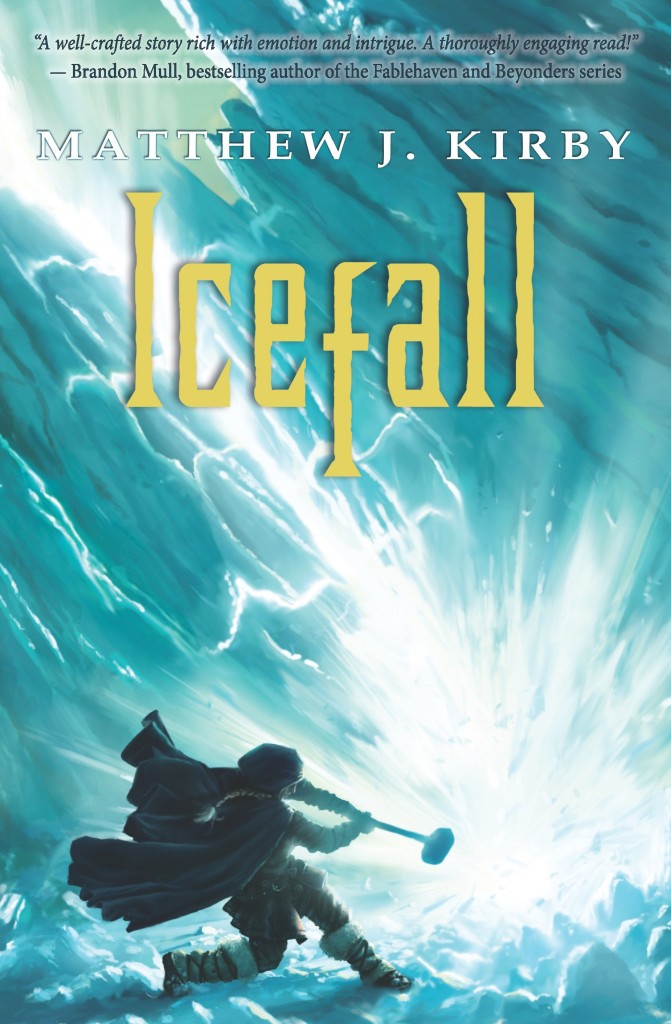
Nordic Magic: Icefall

I have many reading lists going on -- I'm still plugging away at the Best of the Best books, I'm searching out state settings for my Where Are You Reading books, I'm dragging books off consecutive shelves of the library for my Reading My Library Quest, and I'm working my way through all the Cybils finalists in all of the book categories.  Oh, and this summer I'm trying to work my way through the kidlit shelf of my TBR bookcase. Some of these I do for fun (I like the beauty of my Quest, and the strange places picking a book because it's set in a state I've never visited takes me), but the Cybils list I enjoy because I'm guaranteed to find some real treasures.

Matthew J Kirby's Icefall was one such pleasure. It's a finalist in the Middle Grade Fantasy and Science Fiction section, although it reads more as a history than a fantasy to me. There's no magic, no divine intervention, no runic power. There is a belief in gods and ghosts, a respect paid to dreams and portends, as well as a berserker power in battle that robs men of their sentience, but these seem as real to Kirby's characters as they did in a Sutcliffe novel.

Cybils2011-Web-ButtonBGThe biggest evidence of my respect for this book is that I never peeked in the back to figure out who survived or who was the traitor. Despite my usual distaste for suspense, I wanted to stay in the dark with Solveig so that I could appreciate her worries and her loyalties. I had my suspicions based on story conventions, but that actually didn't put me much ahead of the protagonist, who spends much of the book training as a skald and learning to cast her own world in terms of narrative and pacing. The vivid and real hardships and dangers were enhanced by the interior stresses and shifts as Solveig spends the winter learning how to value herself despite the expectations of others, and how to appreciate and see the truth about the people around her as well.
Sometimes I ferociously argued against her decisions and actions, but they always felt real and centered around a true personality. The setting and characterizations were strong, and the first person narration both let me see things that Solveig might miss but also taught about her connections with the other characters through what she reported or ignored.

I'm coincidentally reading Kirby's first book at the same time, and though I'm liking it I don't have the same passion as I did for Icefall. This book I highly recommend, and intend to press upon my younger son (the older one doesn't understand why I took so long to read it).

Thursday, June 7, 2012

Importance of an Epipen: Sidekicks

I rushed Dan Santat's Sidekicks to the top of my reading pile when the library called it home, and I had so much fun reading it that I immediately passed it along to P, who also completed it within the hour. This middle grade Cybils Graphic Novel finalist has bright colors, nifty super powers, and an internal family drama that keeps the emotions real even as the hamster and chameleon fight crime with the help of the superpowered cat and dog.

We do have to point out that the clock in the first panels is drawn incorrectly -- at 6:45 the hour hand of a clock does not point to six but is much closer to seven. This bugged my child from the first page, but luckily the clock does not return after that initial scene.

Cybils2011-Web-ButtonBG
Anyway, the driving conflict of Captain Amazing's neglect of his pets because of his demanding superhero job clearly resonates with many kids, but the sugar coating of delivering the message through anthropomorphic pets keeps the tone light, even as they deal with sibling rivalries and devotion. This was a fun and lighthearted read that charmed adults and kids (X had read it weeks ago, when I first checked it out).

Sunday, June 3, 2012

Cybils Picture Books

My house is still a big fan of picture books, although P usually reads them with me while X takes them off to read by himself. So we enjoyed this years crop of Cybils Finalists, with the boys now old enough to talk about why they liked or disliked things, and to appreciate the art as separate from the text.


Blackout,  John Rocco.  X, P and I cosied up under the covers to read our first Cybils of the year.  We enjoyed the energy of the pictures and the interaction between the text and the illustrations, sometimes contrary and sometimes supportive.  It brought back some good family memories -- the free ice cream we got when the cafe freezer lost power, my New Years Resolution to play more table games, the mom who found a flashlight in seconds flat (not always in my capability, but I've had some lucky moments).  A strong start.

Add caption
Do You Know Which Ones Will Grow?, Susan A. Shea.  I tossed this one to the fifth graders on the way home from the library, and they were in a jaded mood.  How stupid does a kid have to be not to know that inorganic things don't grow?  I tried to push them towards thinking about younger kids, and that maybe the book was more in fun than a quiz, but it was hard.  Even N later took a while to warm up, but at the end the opening pages lured him into the fun.  The transformation were eye-catching; some favorites were cupcake-to-cake and shovel-to-plow.  I knew I had hooked N when he complained that the baby was missing from the final summary page, and then I triumphantly turned to the very last page with the kid waving good-bye, and he was warmly satisfied.

I Had a Favorite Dress, Boni Ashburn.  This bright book is based around the folktale of Joseph's overcoat, as a talented mom adverts disaster by skillfully remaking outgrown items into smaller options -- the dress becomes a shirt, becomes a top, a skirt, down through hair doo-dads and finally an illustration.  The pictures are painted on white and the text hovers on the edge of poetry, while the mom and kid step back a few paces from cloying.  I liked the mom's motto of not making mountains of molehills which the girl is applying by the end, although I'm not sure she knows what a molehill is.  The boys really enjoyed this one, especially N, and A found it relieved the tedium of being sick.

I Want My Hat Back, Jon Klassen.  We actually read this one last year, which gives me a smug, special, in-crowd feeling.  P especially found the understated humor and grisly ending enchanting; I also enjoyed the take-no-prisoners finale. Although the smallest kids might miss the deadpan humor and find the bear's feelings uncomfortable, older and more sophisticated three year olds (and up) should have a blast.


Me... JanePatrick McDonnell. We had fun reading this biography of Jane Goodall, from the finely detailed illustrations done in soft colors the the actual science entries from her juvenile notebook. My boys found the life of an actual scientist to be a good nonfiction relief from the frivolity of most picture books, especially with the good humor on each page.

Press Here, Herve Tullet.  Both of my boys embraced the conceit for this book (5th grade and 7th grade), although 7th grade X couldn't resist cheating a bit.  He recommends it for "kids who like the follow the rules," and P just looks forward to reading books like this with his younger sister in a year or so. N kept this book for extra days, and A gave it a "Good for kids" seal of approval.

The Princess and the Pig, Jonathan Emmett. Both boys gave this book an enthusiastic thumbs up, enjoying both the energetic pictures and the happy ending, with the human staying with the family that loves her and the foolish royals embracing a pig.


So, time for the votes!  X, P, and I all loved Jon Klassen's I Want My Hat Back.  Even though we first read it last year, we clearly remembered it with joy and fun. I did ask them what they would buy as a gift for a child, and P and I would give Herve Tullet's Press Here to the small set. X would prefer to give The Princess and the Pig, unless the kid was a baby, in which case he thinks Press Here is the only one appropriate for the under one crowd.
Wednesday, May 30, 2012

April Family Pick: Feynman

Feynman coverFeynman still reigns as the coolest physicist, and the Cybils Graphic Novel finalist and graphic biography Feynman by Jim Ottaviani (art by Leland Myrick, coloring by Hilary Sycamore) helps him maintain that reputation. Starting with his childhood bedtime stories, which emphasize process and understanding over vocabulary (and accuracy), the comics follow present his progress from a stance of smug reminiscing, writing as if Feynman were telling these stories about his education, his wives, and his work.
Cybils2011-Web-ButtonBG

The pictures kept the characters identifiable for me, with Feynman's beaky nose and wavy hair identifying him from high school through the Challenge investigation. Since my weak visual skills often has me scrabbling to identify who is talking in a graphic book, this consistency helped a lot.

P received a copy as his birthday present from his dad, so we made it the April Family Book Club choice, although it took us until almost the end of May to have the meeting.  P actually stalled out in the middle of the book, and I agreed that at age eleven I also would have found the story of Feynman choosing which university department best suited his career dull, and the bits about his girl-chasing and second marriage incomprehensible. So we talked about what age to read things, and then more about his adventures in youth (tricking the guards at the Manhattan Project, finding the bad valve by pretending to read design documents, safe cracking).  We spent a lot of time figuring out the safe cracking parts, in fact.

Overall, we decided it was a good book for YA and up, but only recommend the first half to the elementary crowd. I'm not sure why it's a Graphic "Novel" since it seems to be a nonfiction biography, but then the nursery rhyme book also ended up in this category so clearly I'm missing something.

Wednesday, May 16, 2012

Bad Ways To Go: How They Croaked

book1
It was good.  (Complete review by my fifth grader)

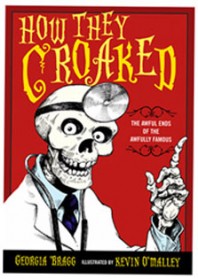
My fifth grade son and I just completed the audio version of How They Croaked, which we both also read last year. Written by Georgia Bragg and read with relish by L.J. Ganser, it gleefully and gruesomely recounts the last days of a variety of famous people, with emphasis on the horrible and failed medical practices that ended them. Ranging from King Tut through Julius Caesar and Cleopatra, stopping by famous presidents such as George Washington (very bad final days) and less famous ones such as James Garfield (the assassination that wouldn't have worked if his doctors hadn't tried so hard), the chapters featured mostly famous people with a few surprises.
Cybils2011-Web-ButtonBG

Each chapter gives a brief history of the featured corpse, with an emphasis on any traits or habits that contributed to their eventual demise. The end of the chapters feature macabre lists riffing off something previously mentioned, from synonyms for "dead" through symptoms of radiation poisoning. The historical and medical details seem sound enough, although I thought Bragg emphasized Curie's preference for her experiments over her children a bit more than the biographies I've read would agree with.

As an audio book in the car, it works very well. Tracks never went over five minutes or so, each chapter ran about three tracks, so it was always easy to find out place (I currently have four audio books running in the car, depending on the audience). If both my sons rode with me, X happily jumped into whichever chapter we were on, without worrying about who died while he was at swim practice or whatever. It's a fun book to read or listen to.

Saturday, May 12, 2012

Blood Red Road: Mean Sisters

Blood Red RoadI know other people have loved this YA Fantasy Cybils finalist, but not me. I found the characters repellent and useless in Moira Young's Blood Red Road. I'm not sure which sister is more repellent,  Emmi or Saba, although I guess we can hope that Emmi could change as she grows up. Saba is slowly learning to be less awful, but not less self-centered or dependent. The world building also didn't make sense; I dislike books with a single magical artifact which serves only to break the suspension of disbelief -- it's a huge crack in the post-apocalyptic setting.

At the start of the book, Saba is firmly established as an emotionally deficient person, who has resented her baby sister for nine years for causing the death of their mom. No, Saba is not ten or eleven at this point, which would make this stunted psyche palatable; she is eighteen. An eighteen year old who still holds an infant responsible for the death of its mother is not a very likable character. Anyway, we soon see that there are other reasons to dislike Emmi, so maybe I shouldn't judge Saba too harshly.

Cybils2011-Web-ButtonBG
Saba spends the book trying to rescue her beloved twin brother who got kidnapped in the first section. She does this despite the assistance of Emmi, who at nine years old doesn't understand that she is not actually in any way an asset to this expedition. Yes, she can use a sling shot, but she also has no attention span, drops things, and has the stamina of a child, slowing down the more robust adults who are racing against the clock to save her brother. Oh well, at least she offers Saba the chance to grow emotionally, and after all, secondary characters aren't there for themselves but to offer Saba opportunities for growth or interaction. Emmi probably only kills two people with her antics, so not much harm done, right? Saba keeps trying to leave her somewhere safe, and is treated as a monster for not wanting to bring her kid sister into various war-zones.

Saba finds a love interest. We know he is her love interest because a magical doo-dad heats up whenever he is around. Also, he has good abs. Saba insults him horribly by not showering him with complements all the time (all the other characters frown so the reader can't fail to notice what a loser Saba is), but he is heroic enough to forgive her once she starts kissing him. I found their love affair emotionally distasteful, but understandable as a pair of lusty teenagers.

At the end of the book, I'm still wondering how awful was the death of Mercy, the neighbor woman who kindly took in Emmi only for the the girl to steal her horse and leave her injured and alone. At the end, the kids decide not to return to see how she fared, because that would be the decent thing to do, and the entire family avoids decency like the pustulent plague. Maybe the sequel addresses this.

The only thing I liked was the voice -- the sparse sentences and tone helped carry me through the story even when every member of this family accepted the love of strangers while selfishly backstabbing them or stealing their stuff. They are the kind of people that make for good stories, but I'd hate to actually encounter them. Probably the main problem was that Mercy was the person I could most identify with, so even though her part was tiny I never got over how the sisters used and discarded her so casually.

My seventh grader liked it a lot; he thinks people make tough choices in a post-apocalyptic world and I'm judging the girls too harshly. He found the plot fast moving, and that's the mark of a good book. 

Saturday, May 5, 2012

Girl Power: Misfit

Finally I finish another Cybils books, a YA finalist in Science Fiction and Fantasy. Jon Skovron's Misfit disappeared with my seventh grader for a while, and he returned it with a strong recommendation. I didn't find the cover all that appealing though, so I procrastinated on the start and let myself get distracted along the way.

Cybils2011-Web-ButtonBGBut the cover fooled me; it's not misleading, because the book does deal with Catholic fears of demons and exorcisms; Jael's father, an ex-priest, keeps her enrolled in Catholic schools for good reasons, but the story isn't a simple one of priest=good, demon=bad (or vice-versa).  Instead, everyone is an individual and makes individual choices, whether they are human and bound to Earth, demon and bound to another plane, or a half-breed with access to both worlds. And Jael is not just a kid with superpowers, she's an adolescent whose father isn't sure how to know when she is grown up, a motherless child whose father still hasn't figured out how to talk about the wife he lost, a Catholic schoolgirl figuring out what she believes and who she can trust. I liked the variety with which people dealt with faith; some people believed foolishly and shallowly, others with heart and soul, and still others dealt with skepticism and questions.

At the end, the book made me look at the roles of a parent and an almost-grown child, the strengths of love in family and friendship, and the worth of loyalty. It's a book that affirms the important things about being human.

For religion month, this book shows a good variety of beliefs among the characters, from devout Catholics to crazed religious zealots through questioning youths and cynical atheists. But for all of them, religion is a real and powerful force in the world.

Friday, May 4, 2012

Sing it: We Are America

We Are America by Walter Dean MyersThe last Cybils Poetry finalist did not really work for me. Walter Dean Myers and Christopher Myers put together a beautiful book, We Are America: A Tribute From the Heart, that combined Walt Whitman-like verses with painterly art depicting scenes from American history, concentrating on the common people who built this country.

Cybils2011-Web-ButtonBGUnfortunately, and this says a lot more about me than about the book, I couldn't really connect. I always felt like I was reading in a cathedral or a museum, with constant reminders to be quiet and reverent. Strong immigrants stood proudly next to victims of prejudice or oppression, and the need to be educated interfered with my ability to appreciate the words or the art. I also couldn't keep my fifth grader interested; I believe he also sensed an attempt to force learning on him and he squirmed away with more than his usual distaste for poetry. So it's undoubtedly a beautiful book, but shallow me could not appreciate it.

I'll go back to Lear nonsense or something.

Monday, April 23, 2012

Creepy Dolls: The Many Faces of George Washington


The next Cybils nonfiction finalist I read is The Many Faces of George Washington, by Carla McClafferty. This oversized book looks at the study follows two stories -- the history of George Washington and the attempt by modern historians to make him more relevant for today's Americans. When focus groups were asked to describe George, terms like "frumpy" and "boring" kept repeating, which shocked and horrified true Washington groupies.  To counter this perception, Mount Vernan researchers commission new dioramas that would feature astonishingly lifelike manikins portraying The Father of Our County as a sexy youth, a powerful general, and a dignified president.

Cybils2011-Web-ButtonBGMcClafferty then starts trading off between a traditional biography of Washington and following the creation of the figures matching each period of his life. The illustration show both scenes and souvenirs from his life and the processes used to replicate the clothes, hair, horses, and bone structure of his person at each stage. I found it easy reading, although sometimes the lifelike images seemed rather creepy. I couldn't interest either of the boys in the book though, not even the one forced to write a report on Washington. They couldn't get interested in how a frumpy green guy like Washington was replicated, which seemed like a chicken & egg problem -- the book was about how these dolls make Washington seem more vibrant and interesting, but their preconceptions held them back from finding out that they were wrong.  Also, they are lazy about reading nonfiction.

Friday, April 20, 2012

Hard Times: Between Shades of Gray

Between Shades of Gray Book
Cybils2011-Web-ButtonBG
Memories of The Endless Steppe haunted my reading of Cybils Young Adult Fiction finalist Between Shades of Gray, Ruta Sepetys's story of a Lithuanian teenager arrested with her family by the Russian police just as World War II swept across the European continent.  Torn from a rather privileged childhood, Lina and her brother have only their mother to protect them as they are herded into cattle cars and shipped across Russia to a succession of labor camps, each grimmer than the one before.

Sepetys gives Lina a believable voice, from her naive and reckless dedication to her art through her understanding of the dangers they face, both from the bullets and blows of their captors to the slow draining of their souls and selves from the unremitting brutality and deceit. Lina tries various schemes in attempts to reconnect with her father, but the realism in the story prevents any of them from succeeding. The cruelty and sadism of the Russian guards are sadly convincing, as are the appalling conditions at the Arctic camp they end up in. Although there is an epilogue providing a hint that some characters survive, overall the story is as tragic as the time period suggests.

I'll see if my son will try this; he's not much for historical fiction. It would be interesting to see if he understand the context; for example, why some people hope Hitler will save them, or the importance of the Jewish man's concealment of his religion, or what happened to the country of Lithuania at this time. (The library wanted it back before I could talk him into trying it.)

Wednesday, April 18, 2012

Father's Quest: Anna Dressed in Blood

Cybils2011-Web-ButtonBG
If your father dies doing something desperate and dangerous, it's unfortunate for your mother if you instantly dedicate your life to following in his footsteps. Luckily for Cas his mom is accommodating enough to accept his passion, to the extent of moving them around the country so he can find his next ghost hunting gig.  But this one is different, which is why Kendare Blake's Cybils YA Fantasy finalist Anna Dressed in Blood starts here.

The first person narrative gave me some of the same problems I had with Witch Eyes; I suspect most teen-aged boys will seem, um, stupid to me during their high school interactions and I prefer the distance of third person so I can give them more benefit of the doubt. But the gradual increase in the stakes -- how is Anna different from other ghosts? Why does Cas feel so strongly for her? And what has he really been doing all these years? These questions raise the book above the teen angst that threatened to trip me up. The end of the book sets up for sequels, but I have to set that this one didn't really grab me. The ended was powerful, but characters other than Cas (and maybe Anna) felt like characters sliding into slots on his team, not people in their own right.

I'll leave this out for my seventh grader, although I suspect the cover will be a hard sell to him. (Weeks have passed, and he's not nibbling. Darn.)

Wednesday, April 11, 2012

New York Mystery: The Inquisitor's Apprentice

My library provided another Cybils finalist for my NOOK, this one in the Middle Grade Fantasy category. Chris Moriarty's The Inquisitor's Apprentice is a fantasy alternate history, placed in a New York City around the turn of the century where immigrants pile into tenements and Gilded Age tycoons make sweeping grabs for power, while magic is both banned and widely practiced.

Sacha is a Jewish boy from the wrong side of the tracks, embarrassed about his poverty and his family's origins in front of the other apprentice, who is embarrassed about her mother's social pretentions. For some reason no one wants to tell Sacha what he is actually supposed to be doing, so he spends a lot of time trying to bluff his way through various situations. He's even more  protective of his family than he is of his reputation, keeping secrets from them for their own good even as he tries to hide their foreignness from his co-workers at the Inquisitor's office.  He's a rather improbable blend of extreme naivete and street-smarts, but I liked Lily Astral, his high society fellow apprentice enough to forgive him many things. It's handy for a bluffer to have a foil who is a know-it-all, although Sacha rarely notices how much Lily is helping him.

The alternate history idea works well, with the magic serving as a window into the corruption and biases of the times while keeping things on a friendly plane. Everyone's magic stems from common stereotypes and tropes of their ethnicity, which helps keep people distinct without forcing them to actually live up to those archetypes.

Monday, April 9, 2012

Cybils Nonfiction Picture Books

Cybils2011-Web-ButtonBG
We've read our way through all the Cybils Nonfiction Picture Books, and the results are in! Our family favorite was I Feel Better With a Frog in My Throat, although I also recommend Bring on the Birds and The Case of the Vanishing Golden Frogs. The Cybils committee agreed with us in this category; our top pick won the award. Thanks to King County Library System for having all these books ready for us.
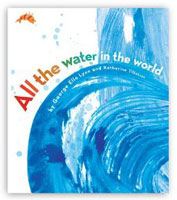
All the Water in the WorldAll the Water in the World, George Ella Lyon and Katherine Tillotson.  This read more like a poem than a science book, with a stronger emphasis on beautiful language, internal rhymes and alliteration than conveying information.  X came along midway through but didn't want the book to reread, which is a sign of low interest (he usually hears us reading the picture books, then comes back to steal them).  P and I liked the pages as they went, but didn't find that either the words or the information stuck too hard.  There was a hard left turn in the final pages towards conservation, which disconcerted me a bit.

cover-bringonthebirdsBring on the Birds, Susan Stockdale.  The summary of this book struck me as dull: a bunch of birds.  But the execution brought them to vigorous life.  The rhyming scheme seemed as natural as the different plumage and features of the birds.  The elementary aged kids all loved it, despite their reluctance to read another  picture book.  N particularly laughed with delight after almost throwing himself off the couch to avoid reading with me.  He recognized a few birds (penguin, owl) but enjoyed all the illustrations and the steady rhythm of the text.  A fun book that shone all the better because of my low expectations.


Can We Save the Tiger? Can We Save the Tiger? , Martin Jenkins This much meatier book is a harder sell for my picture book readers; so far none of the kids has tried it.  The muted colors don't seem to appeal, and the first few pages have enough words that the kids shy from a read-aloud, but it's not enticing enough to read on their own. I thought it a wonderful way to explain the idea of endangered creatures in a less simplistic way -- many times conservation is not as easy as turning off the faucet while you brush your teeth.  It looks at the reasons people encroach on animal's lands and the costs of saving rare animals, as well as the consequences of not doing so. P read it and found it profoundly depressing, but then he's been in a depressed mode lately.

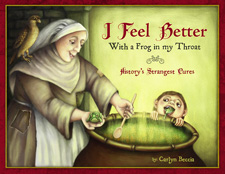
I Feel Better with a Frog in my ThroatI Feel Better With a Frog in My Throat, Carlyn Beccia.  Hugely popular with our household.  Funny subject, funny illustrations, short and sweet explanations that we enjoyed reading out loud.  I think it's a good first look at science as well; the underlying philosophy is that people make assumptions but that testing them for results matters.  Some hypotheses are true, others not so much.  Will be tough to beat.

Planting the Wild Garden, Kathryn O. Galbraith.  Another book I'm having a hard time getting my captive panel to review; apparently we don't "do" muted colors.  A very basic look at how wild plants reproduce, with help from wind, water, wild animals, and even hikers. My children judged this as "OK for little kids." A read it and liked it, and she turned up her nose at Markle and Jenkin's books.

The Case of the Vanishing Golden Frogs: A Scientific MysteryThe Case of the Vanishing Golden Frogs, Sandra Markle.  Depressing but clearheaded look at the tragic story of the Panamanian Golden Frog, which scientists (especially Karen Lips) noticed disappearing, and the investigation to determine the cause.  Unfortunately, the fungus wiping them out is currently untreatable in the wild, so the only hope for the Golden Frog is in zoos.  The book follows the development and discarding of several theories before showing how the fungus was identified, and then follows the creation and execution of the plan to prevent extinction. It kept my guys interested, although P seemed to resent some of the definitions as condescending. They found it gloomy reading, though.

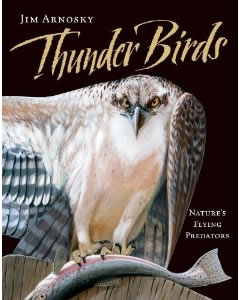
Thunder Birds, Jim Arnosky. The pictures dominate this book -- the fold-out pages show the breadth and majesty of various carnivorous avians. The text describes their habitats and behaviors, with occasional personal mentions of where Arnosky or his wife were when the saw the bird or what they felt. These asides didn't work very well for us; they felt alien to the book as a whole. If I were a librarian I'd be worried about the extension of the pages; it's hard to imagine this book lasting through more than a few second grade readers. 


Tuesday, April 3, 2012

Ambiguous Good Guys: BadIsland


Bad IslandIn the next Cybils YA Graphic Novel, Doug TenNapel's BadIsland, there is a definitely lack of good guys.  There's the inhabitants of the island, who are mostly bad guys, there's the people shipwrecked on the island, a family who doesn't like each other much (although they pull together in the end), and there's the island itself, a victim of hubris that cost his family dearly.

Cybils2011-Web-ButtonBGThere are also pages of fascinating images; TenNaple's graphics sometimes confuse me but never bore me. Even the annoying characters, such as the improbably idiotic little sister and her dead snake, have distinct features and unlikely yet effective perspectives. I find the pictures more satisfying than the story, which follows a family forced by murderous aliens to rely on each other (honestly, if that's what it takes, I'm not sure the family really needs to stay together).  But both kids liked it, so it may be that a middle aged mom is not really the target audience. I bet the lack of space between the words in the title didn't bother them at all, and it's still the first thing that grabs me when I look at the cover. Why BADISLAND? What was wrong with Bad Island? Is it Badisland Island? 

Monday, April 2, 2012

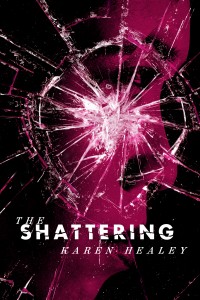
Youth Against the Dark: The Shattering

The Shattering American Cover
Cybils2011-Web-ButtonBG
Down in the South Island of New Zealand, Karen Healey's The Shattering places a perfect town.  It has reliable weather, good schools, a good community, a solid economy and nothing changes.  No one notices. And no one knows the price paid for this loveliness, at least until three teenagers who helped pay that price start to figure things out.

I loved this book because it uses the fantasy as a way to work the deeper emotional themes, but never backs away from the essential realism of the characters. They have crushes, some requited and some not, they have secrets, they deal with their grief and emotions in powerful or childish ways. The things they learn and the things they have to do don't come for free; at the end of the book both they and their world have changed fundamentally.

This is the second year Karen Healey appears as a Cybils YA Fantasy and Science Fiction finalist, and she's probably enough reason for me to love this award. I haven't pushed this book on my seventh grader because I think it's a bit adult for him; the tensions and relationships are clearly high school rather than junior high based.  I'm looking forward to whatever else Healey decides to write.

Sunday, April 1, 2012

Family Fun: Nerd Camp

Cybils2011-Web-ButtonBG
Nerd Camp cover largerFor our March family book club, I picked a Cybils finalist that I had lent P to read on an airplane trip; he much prefers books he has just finished so as to avoid the tormenting suspense of having to read a book. Since X and I easily finish any book on the list we tend to pamper his sensitivities.  So I moved Elissa Weissman's Nerd Camp further up my pile of Cybils finalists (it's a Middle Grade Fiction entry) and then X gobbled it up happily the day after I finished it.  And so it was time for sushi.

The slowest part of the conversation was the lack of controversy -- we all agreed on almost everything. It was a fun book, nerds can have cool fun, and the camp sounds awesome although P thought it would be more fun if X came too, even if they were in different cabins. We kept getting sidetracked into nerdy investigations -- what kind of snake was the Milk Snake that saved Gabe's bacon? How useful is a head-held flashlight, and who was the last one to see X's? How many digits of pi should an educated person know, and does that mean my fifth grader is more educated than me?
It's a fun book for a family, although I do wish A had tried it, as she knows more about the "cool" stuff represented by Gabe's stepbrother, and so could advise us on how plausible the finale was. Thanks, Weissman, for writing a book that gave us a delightful family book club night.

Friday, March 30, 2012

Big Sister Poems: Emma Dilemma

Cybils2011-Web-ButtonBGMy fifth grader and I enjoyed Kristine George's Emma Dilemma, but we definitely treated it as a picture book rather than a poetry book.  In fact, P threatened to stop reading if I mentioned the p- word, but he has a vicious prose preference.  It's true that few of the pages stood alone; the evocative words worked with the illustrations to paint the story of a loving older sister and her sometimes pesky sibling.

It did rub against one of my current sore spots -- false childhood guilt. I dislike reading books that encourage kids to assume guilt they shouldn't own -- guilt is a very healthy emotion that reflects a missed opportunity, not one that reflects bad luck or accidents. When Emma falls towards the end of the story, it was clear to me and P that big sister had nothing to reproach herself for, but of course she feels guilty anyway.  Which I know kids do sometimes, but I've tripped across too much child guilt lately to enjoy it.

Here's my test -- if you look back and you wouldn't change what you did, then you aren't feeling guilt.  (You could be feeling shame, but that implies that you wish you were the person who would change what you did but you aren't.)  You may be wallowing in self-pity, but that's a different emotion, and I want my kids to learn the difference.

But besides my little hang-up, it was a bright, companionable book that we liked a lot.  Our favorite page had the girls playing cards, the mom advocating cheating to let Emma win (P and I were shocked), and the clever but rejected solution of 52-pick up, which had P chortling.  I got A and X to read it as well, since A is an actual big sister, and they also liked it (especially A). We ended up with a fun discussion about poetry -- all the kids were sure it was not a poetry book, but we agreed that a new word was needed for books that weren't poetry but had "picture book" language that felt a little richer than plain prose.

Sunday, March 25, 2012

Sad Girl: Breadcrumbs


Breadcrumbs

Cybils2011-Web-ButtonBGThe latest Cybils Novel (Middle grade Fantasy & Science Fiction) finalist almost broke my heart.  My fifth grader is also unhappy in school, and I suspect that much of our "help" and advice sounds like the fake plastic words that try to smother Hazel in Anne Ursu's Breadcrumbs.  Their troubles and problems are completely different, but their misery and bafflement at what people do to try to help sound crushingly familiar.

Ursu's words and images bring the interior life of a fifth grader vividly to life, and when Hazel pushes out of the real world and into the forest of fables and stories to rescue her friend the metaphors work unerringly -- the woodcutter, the garden of flowers, the match girl. Hazel never gets extra powers, but she almost despite herself clings to an inner core of strength -- she wants to rescue her friend because he was her friend, no matter what happens in the future.

I may request this book from the library again, because I'm curious as to how my kids would like it; unfortunately everyone else in my county wants to read this too, so my copy has to go back.

Saturday, March 24, 2012

Slovakian Heroes: Dragon Castle

Dragon Castle
Cybils2011-Web-ButtonBGOur elementary school book club started the year with Skeleton Man, a Joseph Bruchac book that features  an Abenaki girl who uses the strength and knowledge gained from her family's folk tales to defeat a scary creature. Other books I've read by him also feature children proud of their Native American heritage. But in the Cybils Science Fiction and Fantasy (Middle Grade) finalist Dragon Castle, he turns to his father's people, the Slovakians, for inspiration and tone. The American kids put a huge emphasis on knowledge and competence; the Slovakian one trusts more in intuition and guidance. The feel of their interior lives is very different.

Not that Prince Rashko eschews competence; although he values his intellect highly (especially since he views himself as the only member of his family with a functioning brain) he also lets the reader know that's he's a big, strong, athletic swordsman, just like his simple-minded brother. And despite his towering intellect, he also rarely sees through to the meanings of the folksy proverbs scattered about by his father and other mentors.

The bad guys were suitably menacing, from the casual cruelties of the retainers to the magical attacks of the visiting prince and his beautiful daughter. Although I suspected from the first that Rashko severely underestimated the comprehension of his relatives, I liked how the entire family loved, trusted, and respected each other even when using vastly different tactics. The frequent intermissions to show the legend of Prince Pavol and the founding of the castle help build the themes of the story without slowing down the suspense.

My seventh grader also liked the book; the dragon and castle cover with its gently creepy color scheme enticed him to pick it up a few weeks ago. I'll see if the fifth grader wants to try it. (Nope)