Showing posts with label Science Book 2011. Show all posts

Wednesday, December 7, 2011

Space Wars: Pluto Confidential

Pluto Confidential
The tensions over Pluto's demotion still run high in many hearts, although luckily violence rarely breaks out.  Laurence A Marschall and Stephen F. Maran sit on opposite sides of the Pluto-Planet debate, but still managed to amicably write Pluto Confidential, a history of planet definitions and controversy.  After starting with a description of the organization and meeting that created headlines with its Plutonic decision, they back up into a description of the discovery of each planet and how the planets got names and reputations.

Other planets have been listed and then demoted, stripped of the right to call themselves planets.  I like using terms like that, because after all, every planet is just a hunk of matter spinning around in space where no one can hear it scream, let alone complain about naming rights.  Hunks of matter don't have volition, let alone vocabularies!  Anyway, the sun used to be a planet, but when scientists established that there had been a heretical misunderstanding and it didn't revolve around the earth, it was slapped with the label "star" and told to hush up.  The moon also lost planetary status, but it took it well.

Then new planets were found -- Uranus (aka Herschall), Ceres, Neptune (or Leverrier), Pallas, Vesta, Flora, Iris, Vulcan -- what? what? I'm not listing them in order from the sun, just in order that I remember them.  Some of them later got transmogrified into asteroids, and Vulcan was relabeled a figment of the imagination.  Yes, Vulcan disappeared completely without survivors.  And then Pluto.

I like reading about the partnership between mathematicians and astronomers, because mathematicians are just cool.  Gauss figured out the orbit of Pallas with basically two sightings and a paper clip.  John Adams sent accurate predictions of Neptune's orbit to Britain's Royal Astronomer, who ignored him because Adams had a proletarian accent, thereby ceding Neptune's discovery to the FRENCH.  Oops.

Why are Marschall and Maran on opposite camps? Marschall is comfortable with the IAU's definition of planets, which acknowledges Pluto's non-unique Kuiper belt status.  Maran points out that the main reason there the IAU has a definition of "planet" is to figure out how to name new objects, which is not an issue with Pluto, and that astronomers never get the final word on what to call things anyway -- things end up with the name everyone uses, which is why no one has heard of Hershall or Leverrier and why Jupiter's moons aren't named after the Medici's.  Both are right, and both agree that the name isn't really that important but wow isn't it great that people get so excited about this?  Science is fun!

Wednesday, November 30, 2011

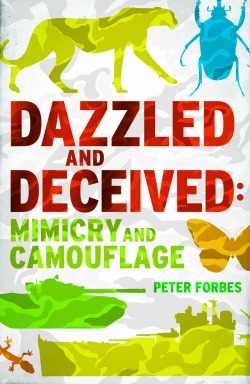
Can't See Me: Dazzled and Deceived

How does camouflage work, and who invented it?  Is a history of camouflage a military history or a Darwinian narrative of biology and genetics?  Well, if Peter Forbes writes that history (which he did in Dazzled and Deceived: Mimicry and Camouflage), it's both.

He traces the discovery of butterfly mimicry and its importance in the development of the theory of evolution, from Darwin's ideas through the controversies of the 1800's and early 1900s, and then turns to the artists who pioneered the ideas of camouflage in World War I.  From there he moves back and forth between soldiers, artists and scientists, following the various attempts at human and vehicle disguise through World War II into the modern day, the fight for precedence and credit for that work, and the theories and counter-theories of animal appearance as the understanding of genetics deepened.

Forbes isn't afraid of going deep into a topic.  The chapters on genetics worry at individual chromosome traits; chapters on naval painting trace which committee listened to which similarly declaiming expert and who officially gets credit for each new technique.  Sometimes the crannies he delves into leave me skimming, while other times I'm willing to follow his interest every step and hope he keeps drilling down.  It's a strange mix of a wide subject, which indicates a more popular touch, and a willingness to bore down into the fine details of the topics of each chapter.  Mostly it works, although I doubt my seventh grader would be interested enough to stick with it.

Wednesday, August 31, 2011

August Book Club: Seven Daughters of Eve

Seven Daughters of EveMy book club has dabbled its toes in some nonfiction lately, mostly with pleasant results. Bryan Sykes's The Seven Daughters of Eve: The Science That Reveals Our Genetic Ancestry is an account of the development of mitochondrial DNA analysis as a tool to trace the ancestral histories of humans. Since mitochondria DNA only passes along the maternal line, it is simpler to follow and less prone to transformation. Instead of an exponentially branching family tree, it traces a single line back from the many to the one.


Sykes shows how this gene helped determine relatives of the ice age man found frozen in Switzerland, the truth about claimants to the Russian throne, the path of Polynesians across the oceans (he was involved in many of these cases). He then looks farther back to prehistoric times, to the seven women almost all Europeans descend from, and imagines what their lives were like and who they were. His tone is conversational, even when explaining the science behind the gene, and he's just as interested in the politics behind labs scrambling for credit as he is in the experiments driving the discoveries. It was interesting to read about some of the protocols, especially regarding children, which just seemed so different from how I think science works in America (Sykes is English). Also, his glee in an invitation to a castle to sip wine with a lord checking on his connection to a cave man amused me.

The women in the club mostly enjoyed the book, and we talked about how Sykes approached the material and presented it to the public; we pushed at some of the hints he dropped and then jokingly compared some of the more whimsical "biographies" of the prehistoric women to the last Clan of the Cave Bear book that recently came out. It was a fun evening.

Sunday, July 31, 2011

Vacation Catch-Up

I have been warming myself in a state with an actual summer, but due to a strange digital architecture, I was unable to blog.  This means that the network connection from my bed was poor.  This seemed to be an enforced vacation maneuver, since everywhere else in the room was fine; just not the bed.  I took it as a sign.

But I kept reading!  So here are five books that I've read, to start to make up for the ten days without reports from me.  I read them all on my NOOK; all but the last were borrowed from the library.

  1. Over the Edge (Troubleshooters #3), by Suzanne Brockmann.  Since I liked half of the Brockmann's I read before, I thought I'd give this ebook a try.  It was a bit too long but readable, with rather silly romance misunderstandings mixed in with rough, tough anti-terrorist plot action.  The main romance was easier to take; although the helicopter pilot and the tough Sergeant kept misunderstanding each other, they had fairly solid reasons for not talking to each other, at least for the first 50 or so pages.  She's young but vulnerable and thinks he thinks she's just a kid.  He's older and uglier, and thinks she wants someone closer to her age.  The secondary romance was more annoying -- the couple disliked each other but were wildly attracted until they suddenly realized it was TRUE LOVE, and then a foolish pregnancy subplot ruined everything.  A final historical subplot also annoyed and bored me -- a Danish maid and the son of her Jewish employers fall in love, but his parents disapprove because they are BAD.  I probably won't look for more books by Brockmann, although maybe I'll try her gay short story because if the romance is all men I won't have to worry about a stupid pregnancy plot twist.
  2. The Cardturner, by Louis Sacher.  This is a love story and a ghost story about bridge (the card game).  It's a good thing that I've always liked Sacher's books, because otherwise I doubt I would have touched it with a ten foot pole, but I trusted the author and he delivered.  I liked watching the hero become fascinated with bridge tricks, although I found his family more of a caricature than characters.  I've recommended it to my bridge playing friends.
  3. Confessions of a Prairie Bitch: How I Survived Nellie Oleson and Learned to Love Being Hated, by Alison Arngrim.  I seem to have stumbled into an appreciation of celebrity memoirs, but although the writing wasn't as smooth as Steve Martin's this story of growing up in a Hollywood family, most happily on the set of Little House on the Prairie was also entertaining.  Arngrim is matter-of-fact about some of the unsavory parts of her story, mostly based around her family, and amusing when she described the bizarre interactions she had with fans of the show, who usually hated her.  At the end, she's proud of using her childhood fame to help strengthen laws against child abuse, a very personal cause.
  4. Weekends at Bellevue, by Julie Holland.  Once I got over my culture shock in the first paragraphs (I picked the book because I remembered seeing in on a "local interest" table at a book store, but the Bellevue is not the nearby small city but New York's crazy hospital) I found this memoir gruesomely fascinating.  Holland does a good job describing the variety of people who end up, by choice or circumstance, at the emergency room of her mental hospital (she ran the ER on weekends for many years).  I found the personal descriptions of her life more distancing; I don't think I'd want her for my physician or possibly my neighbor, but neither of those seem likely. 
  5. Ghost Ship, by Sharon Lee and Steve Miller.  Another piece of the Liadan story, with all the usual strengths and weaknesses.  The plot lines for Theo Waitley, Clan Korval, and mysterious technology bits come together with a fun page-turning eagerness, but I wish for a greater sense of jeopardy -- too often strange coincidences save all our favorite characters, who are all guaranteed true love and happiness.  I was set to love the ending, but then the final pages left all in doubt again.  Hey -- last book in the series (for now) -- that's a 20/11 Challenge category.

Monday, June 13, 2011

Price of Greatness: Obsessive Genius

After picking through the bibliography and sources of Brian's biography of the Curie family, I choose Barbara Goldsmith's Obsessive Genius as my next book to read in this stream.  (A stream of books is a sequence where each book references the next one.)  Instead of spreading itself across all the Curies, this book concentrates on Marie.

Goldsmith seems a bit more willing to be critical of Marie, casting a more suspicious eye on the funding of her laboratory, her insistence on personally holding the standard setting curie of radioactive material, her complicity in promulgating the myths surrounding the discovery of radiation, and the possible estranged relationship between her and her daughters.  Since my current interest in Marie Curie began with a poem about the women in the family, I found the last issue particularly interesting, as well as the different angle on her scientific achievements.

Reading several biographies in a row encourages me to focus on the differences; I can see how Dennis and Goldsmith can read the same primary documents and come to different opinions.  Since I've never come close to those documents, I don't yet have an opinion toward which is right, although it would be a nicer world if it were true that they all got along.  As a person who did enjoy maths, I don't assume Irene was ironic or desperately trying to gain her mother's approval when she wrote asking for more problems; I also don't find it ludicrous that a child was working on what is generally considered high school math problems.  But it's certainly possible that she hated it.  The teasing between Eve, musical and fashionable, and the clothing oblivious scientists Marie and Irene could be read as mean and belittling, or it could be cosy and affirming.  The entire family knew they were on stage; it is certain that Eve deliberately chose the image she wished to portray.  The tension between the women's obvious talents and the reluctance of the world to acknowledge female intelligence makes the science and lives of the Curies fascinating; I clearly haven't finished following the connections along this theme.

Monday, June 6, 2011

Doctor Danger: The Secret of the Yellow Death

The yellow death was a virulent disease that killed thousands of people, young and old.  Until the twentieth century, no one knew what caused it.  In The Secret of the Yellow Death, a Cybils Middle Grade and Young Adult Nonfiction Finalist, Suzanne Jurmain tells the story of the doctors hired by the American army to study and prevent the disease.  Along the way they also pioneered the ethics of human experimentation, moving from using themselves as test subjects (one died during their investigation) through informally inviting men to get bit by a mosquito, through formally listing the dangers and the rewards of participating in tests.

Jurmain clearly points out the risks and the scientific questions involved, building suspense as the doctors perform experiments and also fall sick to the disease they are studying.  She does a good job of showing the scientific process, as well as discussing the risks involved.  I was fascinated, and I hope to entice the boys into reading it as well.  A

(The Amazon link should benefit the Cybils committee.)

Monday, May 2, 2011

Runs in the Family: The Curies

After reading Borrowed Names, I wanted to know more about Irene and Marie Curie.  So I checked the bibliography and ordered up one of the reference books.  The Curies: A Biography of the Most Controversial Family in Science starts with Marie and Pierre Curie and continues with daughter Irene, her husband Frederic Joliot, and daughter Eve.  I think the standard of controversial science families must be rather low, since the main controversy seemed to be that Marie and Irene were both women (!! yes -- it is true!!).  Well, Marie Curie was accused of having an affair with a married man once, and Frederic Joliot became a communist, but then so did most of France (both have affairs and become communist).

Denis Brian does a good job establishing a narrative.  He often has several strands going; he traces the families and childhood of both Marie and Pierre and then later follows both Eve Curie's travels as a journalist and Frederic Joliot's work in France during and after World War II.  Joliot gets more attention than Irene from their marriage onward, which was a bit of a disappointment for me since Irene was my main interest going into the book.  Borrowed Names was about the relationship between Irene and her mother, and this book gave me more of the facts behind the events mentioned in the poems.  I wish there had been a bit more explanation of the actual science, especially for Irene and Frederic, because sometimes that got lost in the descriptions of the arguments between scientists.  But I got a sense of the transition from the work the early Curies did in a shed to the more elaborate work of Irene, and finally the gigantic systems Frederic's late work required.  And the transition from the pure science of the early discovery of radioactivity through wild enthusiasm of its potential for good to the horror of the atomic bomb.

I'm interested in continuing to learn more about the Curies, perhaps with a stronger look at the science behind their work.  B

Friday, April 8, 2011

Science Is Cool

April is Science Fair Month, and in honor of science I'm joining the Science Book Challenge.  I pledge to read 3 (or maybe 3.14) books with some connection to science or that I can argue convincingly belong to the theme "Science and Culture", and then tell the people at Scienticity about them.  I'll also pester my kids to read more books about science, but I do that anyway.

What science fair project are we contemplating? One that requires three bottles of soda.  The kids choose their science wisely in terms of getting the treats they like as part of their science equipment.  Then we'll use the bottles to examine water pressure vs gravity in the trajectory of water streams.  Thanks to TheHappyScientist.com for the idea for the experiment.

Because the whole point is to spread the news about good (or bad) science books, I'll go ahead and list what I've read so far that would qualify, although I feel I should read 3.14 books starting from now:
  • Dinosaur Mountain, by Deborah Kogan Ray.  The Cybils nonfiction finalist about early paleontologist Earl Douglas.
  • Dark Emperor, Joyce Sidman.  This poetry book is graced with a science sidebar on each page, discussing the traits of the animal featured in the facing poem.
  • The Global Warming Deception, Grant R. Jeffrey.  This awful book seemed to think it included a rational discussion of climate theory.  Well, rational if you get most of your data from opinion columns, which do not actually have evidence of anything in them.
  • The Hive Detectives, Loree Griffen Burns.  Beautiful and fascinating description of bee lives, bee deaths, and the scientists who investigate them.  Although a picture book it has a good degree of detail.
  • All Cats Have Aspergers, by Kathy Hoopman.  A simple picture book describing how many people with Aspergers perceive the world.
  • Ants, Melissa Stewart.  Easy read picture book that talks about what ants are, how they live, and who studies them.
  • Borrowed Names, Jeanne Atkins.  A poetry book about mothers and daughters, including a section about Marie Curie and her daughter Irene Curie-Joliot.
That's a pretty good start.  Five of those books are children's books from the Cybil's finalist list, which includes a nonfiction picture book category as well as a general nonfiction section, although the poetry and easy reader categories also provided some science books.

Now, books I've read after starting the challenge: