Showing posts with label 2011 A-Z. Show all posts

Saturday, December 31, 2011

Alphabetically Scrambling to Finish off 2011

Things have been quiet around here as I try to finish up my last challenges while still celebrate the holidays with my family.  Now I'm holed up alone in my room chasing down the last few pages.

The A-Z challenge had a few leaves that were hard to shake from the tree, but I've finally knocked them down.  Coincidentally they also helped me round out the Global Reading Challenge, which was looking a bit anemic. During the holidays I've read the following on my NOOK, completing the A-Z challenge:
  • Jasper Jones, Craig Silvey.  An Australian coming-of-age story where the narrator learns about the fronts put on by everyone around him, proving that he doesn't have to doubt himself if his own courage and self-confidence aren't always bone deep.  The twin mysteries of his parents' marriage and the murder of a school mate implicating the notorious Jasper Jones provide the lens focusing these revelations, as well as the minor bits of plot that accompany the journey of interior growth.  I also learned a lot about cricket.
  • Wife of the Gods, Kwei Quartey.  Darko is a police detective in Ghana, where modern investigative techniques run parallel to rougher, simpler modes of justice, with magic and witchcraft lurking in the corners.  Darko's sense of fair place and justice stem from his own mother's disappearance, and the chance to solve a murder in his mother's home village also gives him the chance to peer into his own family's secrets.  An interesting glimpse into Ghana culture as well as a detective story.
  • The Space Between Us, Thrity Umrigar.  Rich Parsis and poor Hindu workers may think that their friendship can transcend an employee-worker relationship, but the rich will betray the poor every time.  Poor and uneducated people always lose, and it's because their poverty leads them open to bad choices based on smaller understanding.
  • One Man's Bible, Gao Xingjian.  Another book translated from Chinese that felt like it was written behind glass -- somehow I've never been able to connect with any I've tried.  It didn't help that women in this book were considered alien creatures there to either inspire lust or to fail miserably in that purpose.  The tricks with pronouns didn't illuminate much to me; the whole book felt false so the changing identities didn't resonate deeply.  The parts set in the past at least gave a sense of setting and reality, as opposed to the much vaguer parts in France or other western cities.  As a "fictionalized account" of the cultural revolution it worked better than as a "meditation on exile" and "the essence of writing" (from the B&N description.)

Friday, December 16, 2011

Reading High: Queen's Play


Someone may have noticed the quiet around here.  That's because I'm frantically pawing through books trying to figure out a path to finishing all my challenges before the end of the year.  I really want to finish the Cybils finalist list, but the super-depressing YA offerings really slowed me down.  I'm now on the last one, so I'm comfortable reading about 50 pages a day through the weekend, and then I'll write up a final post of all the last-minute books plus the ones I skipped reviewing somehow.

Meanwhile I've loaded my NOOK with books to finish off the Alphabet challenge, which means I can flail about to see if I can find things for the geography puzzles.  Of course, just because I'm in list crisis mode doesn't mean I stop Reading My Library or poking at my TBR list.  Oh, and a bunch of library books are coming due as well.  And I hear some holiday or other is coming up, or so the kids tell me.  I think I'm supposed to be doing something, rhymes with hopping.  Stopping?  Flopping? It'll come to me.

Anyway, I managed to finish a book!  And here's a review!


Queens' PlayWhen I volunteer in the elementary school library, I hear a lot about choosing books at the correct level. The idea is to pick books that you can comfortably read, not too easy and not too hard.  Although I'm certainly willing to help kids find books in this magic range, I don't actually subscribe to the philosophy.  I think that interest and enjoyment are the main reasons to pick a book -- I certainly don't turn down a book just because it is "too easy" for me.  Hey, I still like picture books and I've really enjoyed some of the Easy Reader choices from the Cybils challenge and my kids and I rarely drop a series just because they've grown past it -- when is Cynthia Rylant going to write another Mr Putter book anyway? (I just checked -- I'm missing the latest one.  Humph.)


Of course, with all my sophistication and wit, not to mention my lazy habits, I rarely find myself reading a book that would count as "too hard."  But Dorothy Dunnett can really put me in my place.  I just finished the second book in her Lymond series, Queen's Play, and it took me several tries to get into it and I found myself trying the dictionary on my NOOK (uselessly; we seem to share the same vocabulary) or typing phrases into babelfish to try to understand the French or Latin quotes the characters toss about.  Actually, this book had more in-line translations than the first, and less German and Spanish.  But after only eighty pages or so I was having far to much fun to stop, even when I had to pause to try to figure out what the text was hinting at.  It's not just the language that's tough -- the author also expects the reader to stay on her toes and notice connections and intrigue and subtext and whatnot.  A really delicious journey, but not for the lazy-minded.  I'm very glad that my need for a "Q" title nudged me into trying this book a second time.  Although choosing 500 pages books for the frantic end-time does raise questions about that wit I claimed at the top of this paragraph.

Monday, November 14, 2011

Damaged Kids: Zebra and Other Stories

Image of item

I use book challenges to prod myself into reading things outside my comfort zone, books I'd never noticed if I wasn't fulfilling some arbitrary goal.  Sometimes these are books that's I'd have read eagerly anytime I noticed them, but it took some silly challenge like finding a book that starts with the letter Z to stumble across it.  For example, I have no idea that Chaim Potok wrote a book of short stories called Zebra and Other Stories until I was casting about in the library catalog to fill that hole in my A-Z challenge.

Potok delivers the highly articulate children that I know from his novels, but the kids in these stories deal with family problems and solutions.  They also are not conspicuously Jewish; some are explicitly Christian.  Each story confronts the child with a detailed tough situation, from obvious problems such as an injury through damaging secrets and family conflicts.  I recognized themes from his books (loyalty to one's family and parents balanced against personal needs, the pain caused by rigid gender roles, the inherent decency of children), but short stories give a chance for single facets to shine.

Sunday, November 6, 2011

Kids Dying Young: Yummy


The latest 2010 Cybils Graphic Novel (Young Adult) finalist book definitely represented a change of pace.  Yummy: Last Days of a Southside Shorty by G. Neri delivers a tough history lesson about the decaying culture of the Chicago southside, where children turned to gangs for support, and the gangs exploited the kids by using them in violent crimes for which juveniles received almost no punishment.  Neri invents a child to view the events, someone who played with Yummy when they were small and who never knows whether Yummy has turned up to bully him for lunch money or to show off a frog found in the sewers.

When Yummy tries to impress his gang leaders by shooting a rival, his world collapses.  He kills a neighborhood girl instead, and the authorities who ignored him while he stole cars and mugged his peers instigate a man-hunt (a boy-hunt) that leaves Yummy terrified and lost.  The nation solemnly discusses Lost Youth and gang violence while Yummy huddles in derelict houses and under dripping bridges, until the gang decides he's more trouble than he's worth.  My seventh grader had eagerly grabbed this book (he loves graphic novels) and then indignantly told me that it wasn't fit for kids.  He views the death of children as too harsh for his eyes, and he was shocked to learn that it basically told a true story.  Neri tells a powerful story, but one that is probably more appropriate for high school than junior high. Sad that the boy in the story might still be in elementary.

Thursday, September 22, 2011

Eff is Off: Across the Great Barrier

Across the Great Barrier (Frontier Magic, Book 2), the second book about Eff, thirteenth child in a very magic-intense family, spends a lot of time roaming about the countryside, which is more pleasant than it sounds.  After the first book covered her entire childhood, the next installment slows down to observe Eff's deliberate attempts to define herself.  She resists her brother's love of college and instead attaches herself to the professors at the local institute, earning herself a place on several expeditions so that we all get to see the complex magic/natural ecosystem and the new animals Patricia Wrede seeded her alternate North America with -- saber toothed lions and petrified field mice included.
I liked hanging out inside Eff's head -- she's modest but capable, and starting to take a more active role in understanding her magic rather than surprising herself with constant failures and occasional spectacular successes.  She continues to love her dangerous brother with an unerring loyalty, but she's emotionally more aware of herself and him as distinct people, each with their own strengths and weaknesses.  I'm looking forward to the next installment of the Frontier Magic books.

Wednesday, September 7, 2011

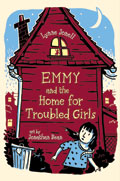
Emotional Blackmail: Emmy and the Home for Troubled Girls

Emmy and the Home for Troubled Girls
Lynne Jonell's Emmy and the Home for Troubled Girls is the second book about Emmy and her friends the rats.  In the previous book, Emmy escaped from an evil nanny who casts spells making her parents uncaring and her classmates unable to notice her.  After a horribly lonely and lost time, Emmy recovered her family as well as the ability to understand rodent speech and a friendship with several rats and chipmunks (honorary rodents, I guess).  But she still has only one human friend.

At the start of this book, Emmy really wants to make friends with girls her own age.  Most of the emotional arc of this book follows her punishment for this horribly selfish desire, until she repents and saves everyone and her former friends (and even one human girl!) reluctantly let her back into their good graces.  This is a bit of an exaggeration, and I suspect that any kid who read this book would not recognize it from that description, but I kept wanting to reach into the book and tell Emmy that it was OK to still hurt after the abuse of the previous year, and that if the creatures around her didn't support that then they weren't good friends.  Instead, Emmy hesitates to intervene when an annoying (but saintly) rat accosts her while Emmy is attempting to talk to some classmates, resulting in an injury to the clueless rat that Emmy blames herself for .  All her old friends, rat and human, now hate her for letting the rat get hurt, while I blamed the author for setting up the poor girl.

In between this there is lots of good adventure, people turning into rats, people living in dollhouses, six year olds clobbering soccer balls, and other good stuff.  I suspect my fourth graders would enjoy it a lot, but my biggest impression was the red light indicated moral failure when Emmy preferred trying to make friends for the first time in over a year to hanging out with the rats who helped defeat the evil nanny.  The patterns of children's literature all screamed that this was the tragic flaw that would lead Emmy into her great fall, but only gross authorial shenanigans wrangles any harm from "weakness."  Humph.

On the plus side, the authors name starts with a "J".

Sunday, September 4, 2011

It's Not What It Looks Like: Xenocide Mission

I'm hoping to get most of my A-Z Challenge books just by normal reading, but sometimes I make a bit of an effort.  For example, I don't actually read that many books that start with the letter "X" so on a trip to the library I typed in a few words to see what I found, and Ben Jeapes' The Xenocide Mission came up.

Ironically, I could actually use this for the author as well, since I'm missing "J" there as well, but I figure it's easy to browse the library by author; harder by title.  This book seems to be the middle of a series, but I just took it as having a rich backstory, with humanity partnering with an alien species on a new planet.  Only we get to watch them as they spy on a third species, one seen destroying the civilization on another planet in their system.  Soon a war springs up, and humanity assumes the worst, but Our Heroes soon discover that the story is much more complicated.  The various aliens are shallow but consistent, with the emotional tone staying light and on the juvenile level, but in a straightforward way.  It was a fun easy read on a pretty summer day, especially one where I spent a while waiting in a coffee shop.

Tuesday, August 23, 2011

Silly People: Vengeance

When preparing for the Read-a-thon last June, I picked up a scattered selection of books to fit any mood, including a few westerns. I paid no real attention to what I was getting, which means that I fell victim to Sturgeon's law and got some lousy books. I'm sorry to say that I classify David Thompson's Vengeance among these.  

In fairness, this is book #43 in the Wilderness series, so I'm clearly starting in the middle; maybe the characters spent so much time displaying common sense and humanity and competence in the first forty two books that Thompson felt readers would be bored if he inflicted any more of that on them. Instead they display a variety of incompetence and petulance. Lou goes for a walk and almost gets lynched, then complains when the man who rescued her doubts her ability to single-handedly defeat the evil pair who wander about murdering and plotting vengeance willy-nilly. Zach suffers from an author who alternates praising him to the sky with forcing him into endless defeats and foolish mistakes. It's too bad television wasn't invented yet, because he could have learned a lot from watching Knight Rider in battle. Or even watching Spritle and Chim Chim in action.

I did have to admire the concept, though. Zach is a half-breed (the term is used repeatedly by everyone, including the author) who resents the contempt showered on him by whites, although his (white) wife Lou can't understand why he's so stressed about this. He has just miraculously escaped hanging when a jury failed to convict him of the murder of two white brothers; society is furious at this gross miscarriage of justice, since clearly the half-breed deserved to die. But, this is all part of the VENGEANCE of the dead men's sister, who bribed the jury to acquit so she could have the pleasure of torturing the man herself. To cover her tracks, she immediately has everyone she talks to murdered, sometimes in public restaurants, using her ginormous indentured servant/lover for the dirty work. Luckily the law can find no evidence, stacks of corpses piling up in the houses she rents being too circumstantial to act upon. Zach apparently believes his gun has a range of about ten inches, so he spends the book having his weapons slapped away by the bad guy. I just wish I could just give these guys the mobile number of a Sackett.

Friday, August 5, 2011

Round Up 2

Here's another catch up post of five books I read on my summer vacation:  Now I'm only three behind on my daily book posting.  Notice I'm not behind on reading, just bragging about them afterward.

When I'm reading books, sometimes I'm having fun while reading them, and sometimes I enjoy having read them.  Ideally I like both -- those are my favorites! -- but sometimes I'll roll along in a story but afterwards regret the time spent, or find that unpleasant memories linger longest.  Other times I'll cringe through the text, but afterward find that my soul has stretched and strengthened and I like myself better now that I incorporate that book.  Or just that I've got a good memory stored away from hard winter nights.  And then there are the books that I read while wishing I were better at putting books down -- reading is painful and all memories of the book will burn my brain.  Blogging helps me pick out which books I'm reading for which purpose, and maybe in my next life I'll be better at aiming at the golden quadrant.

  • Truth and Beauty, Ann Pratchett. (NOOK) I always meant to read Autobiography of a Face, the story of writer Lucy Grealy; the descriptions of it in Daedulus book catalogs looked fascinating.  Sadly, it's still on my TBR list. But the memoir by Ann Pratchett of her friendship with Grealy and her delight in Grealy's brilliance and unbridled race towards life and happiness, as well as her equally impetuous drive towards misery and failure gives a poignant description of a relationship between a grasshopper and an ant who never tired of each other.  As an added bonus, Pratchett ends up in Tennessee, so I'm crediting my state quest here.
  • The Eternal Tomb: Oliver Nocturne 5, by Kevin Emerson.  I liked this book because the author's name is Kevin, but otherwise it was a pretty blah read.  I read it as part of the Read-My-Library project, and it's a middle book from a series in the children's series section.  It's a boy book about vampires, so I'll tell my son about them; he could race through them but he'd insist on reading in order.  It seems to be like Animorphs in terms of reading interest; if you don't know what those are it is unlikely you'd be interested in this. Not much fun, not too many good memories.
  • The First Cut, by Dianne Emley:  I picked up this book because I saw an internet book club going through authors by the alphabet, which I like because of my A-Z challenge.  Unfortunately, my current library stack of 65 items meant that I didn't read it until the month after its selection.  It's a murder suspense story, so a bit gory and scary, and I think it's the first of a series.  It's a cop procedural, with the twist being that the main character has just returned to work after being dead for a few minutes after an on-duty attack.  She's still dealing with the ramifications, from panic attacks in nice homes to strange communications from the victim.  I would have preferred to skip the woo-woo stuff altogether, since it didn't really fit in with the gritty realism of the rest of the book.  I had more fun reading the book than I did thinking about it afterward.
  • The Search, Nora Roberts.  Our July book club book was an unabashed beach book, chosen for that very characteristic.  Orcas Island, off the coast of Washington, stars as an important love interest, along with the word working, laconic hero and the dog-handling reserved heroine.  Many of the women in the club found the man's terse, sometimes rude manner unlikable, but I figured he made up for it by his habit of carving deck rocking chairs and dropping them off at her house.  There is some ickiness with an ooky serial killer, and Roberts seems to take as much joy in describing the horror scenes as with the love scenes, but as the book is meant to be read in bright sunlight (never candlelight) I guess she felt she had to impose her own darkness.  A fun read if you find it in your beach house, but not really worth hiking into town to pick up.
  • No Where Near REespectable
  • Nowhere Near Respectable, Mary Jo Putney.  By now I'm reading the Putney books mainly out of habit; the anachronistic feel of her regency romances has become familiar while the strange situations feel impossibly contrived.  Her current series follows alumni from an incredible boarding school who all find themselves astonished to be in the nineteenth century.  Yet this one crossed over so many implausible hurdles as to almost transform itself into alternate history, allowing me to relax and enjoy the story with its strong female lead dashing about using her special snowflake knowledge of martial arts and birth control and the equality of women while the more hesitant man followed along with his reported death and fancy club owning and master of disguise abilities.  The conversations are often earnestly insane but in a warm and fuzzy sort of way.  It's not a book I'm proud of enjoying, but I can't quite begrudge myself the time to read it.

Monday, July 4, 2011

Giddy-up With a Splash: Whale Rider

I listened to The Whale Rider by Witi Ihimaera because of the 48 Hour Reading Challenge.  I had picked out a few audio books because I wanted to be able to keep reading even if I had to drive anywhere.  As it turned out, I basically stayed home for the weekend except for one quick pickup, so I only got about fifteen minutes in.  At first my kids were listening in, but I spend a lot more time in the car than they do, so they fell behind.  By the time I got to the whales dying on the beach scene, I was fairly glad they had.  I'm not sure I could handle watching them listen to the death of the whales.

Usually I only listen to books I've already read; I dislike the lack of control I get from an audio book; the narrator doesn't speed up or slow down at my mental commands, which I do a lot when reading a book.  But I enjoyed this one, maybe because I'm a sucker for non-American accents, and I found the description of Maori life in transition enough to grab my attention even in the staccato rhythm of listening to a story on my mainly short jaunts across town.  Strangely, my favorite sections were the ones in Australia and New Guinea, which I guess makes sense given my single complaint.

The appendix said that the author wrote this book for his daughters, but there is a real dearth of female agency in the book.  Kahu doesn't make many decisions, just quietly tries to please her grandfather and quietly accepts his contempt for her as just.  Even her final moments of mounting the whale seem passive, as if she is following a script destiny laid for her.  I much preferred hearing about the narrator growing up, learning more about his traditions, going abroad to work and then returning home, with his compassionate but nonjudgmental view of the grandfather's unfair treatment of Kahu.  I've never seen the movie, but I see it's streaming on netflix so I guess I'll give it a try.

Tuesday, June 14, 2011

Coming Attractions: Heroes Return

Heroes ReturnMoira J Moore's Heroes Return is the latest in the story of Lee and Taro on a planet far far away.  The planet has subsided from science fiction into fantasy since its colonization, and now various forms of magic form much of Lee's research interests.  This is the fifth book in their story, and my enthusiasm dwindled a lot in the second and third.  I saw this book on the New Shelf at the library and picked it up on a whim; it was slightly improved but not enough for me to seek out the next books.

At the books core is the relationship between the heroes; Lee is emotionally naive and clings to rationality while Taro is all flighty and pretty and falsely shallow, but somehow they have found love.  In this book some Bad People try to pry them apart by making Taro jealous, but nothing really comes of it.  Lee experiments a bit with spells, but we don't learn anything.  Taro's mother continues to make trouble, but nothing comes of it. The Emporer has some nefarious plot against them, but nothing comes of it.  The book feels like a launching pad for the next bit of the series, but it doesn't have enough substance to stand on its own.  C

Wednesday, June 8, 2011

Bros Before Ho(rror)s: Nightlife

Nightlife Web 1244x2000 Book Series: The Cal Leandros, Chimera and Trickster NovelsRob Thurman writes an urban fantasy series about two brothers standing together against things that go bump in the night.   came in midway with her entry point Blackout, where she gives younger brother Cal amnesia so she has a chance to gradually bring people up to date. That one was fun enough that I picked up Nightlife (Cal Leandros, Book 1) on a later trip to the library.

It was interesting seeing the same backstory through a different lens; a lot of what Cal slowly pierces together later happens in this book and a lot of the things the men did to protect each other have more resonance now that I see more of the memories behind the actions. It does teeter on the edge of too much emotional handwringing, and I hope some book somewhere addresses where the older brother got some of his awesomeness, but it was a nice book to help me glide through my reading slump. I'll probably eventually read the rest of Thurman's books.  B+

Saturday, June 4, 2011

Book 6: Peter and the Starcatchers

ABCABC -- I have detected a pattern! I read a real adult book, then a SF book, and then a kids book.  Since I've repeated this twice, it is now a tradition, so it will be painful to change.  Hmm.  This may help me pick my next book.

I just finished Peter and the Starcatchers by Dave Barry and Ridley Pearson.  They wrote this as a prequel to Peter Pan, so it explains how he gets his powers and his fairy and his peers the pirate, the savages, and the mermaids.  Which is all fine and a decent standard boy adventure story, complete with lack of mortality (I prefer the corpse littered stories of Joan Aiken, but I understand some men are squeamish about such things), but the unexamined misogyny really disturbed me.  Females are few and far between in this book; there is the useless and fat governess, the intrepid girl heroine who credits Peter with saving the day, and the mermaid.  Which stuck out like a sore thumb was the instant hatred the girl and the mermaid have for each other, supposedly because of their jealousy over Peter.  Because of course the only thing that matters for females is their connection with the alpha male; tiny issues like saving the world pale behind such primal instincts.  By the way, it never occurs to any of the other boys to even consider resenting Peter's special relationship with the girl; after all, the boys are friends and it's impossible to imagine them squabbling over a girl.  They barely even mention her, in fact.  Humph.

Thursday, May 26, 2011

Bad to the Bone: Blackout

Blackout 1240x2000 BLACKOUT: Cal Leandros, Book 6Rob Thurman writes an urban fantasy series that I haven't been reading. The latest installment, Blackout (Cal Leandros, Book 6), is clearly an attempt to lure in readers who usually hesitate to start in the middle. Since I am a reader who delights in starting in the middle, I figured I'd encourage authors to encourage this by reading the book.
The gimmick worked for me; Cal Leandros wakes up on a beach with amnesia, and starts trying to figure who he is and what he does. His frantic brother finds him quickly, but his memory returns very slowly, giving him most of the book to interact with his former friends, peers, acquaintances, enemies, and lovers. Thurman doesn't bury the current story with backstory; in fact, Cal's family deliberately lets him rediscover most of his background instead of pushing forward with their memories of him. This gave me a slow and fun introduction to the setting and characters, which is important since both have some rough edges that might put me off. I'm off to get the first book in the series now, because I want to see if Cal was right about who he was, and what his brother does for him.

Tuesday, May 24, 2011

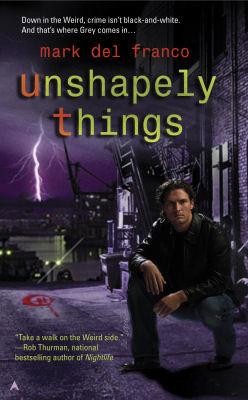
Defective Druid: Unshapely Things

Mark Del Franco writes an urban fantasy series (starting with Unshapely Things (Connor Grey, Book 1)) about a druid, Conner Grey, who used to be a hot-shot with magic, but has been sidelined with a work-related brain injury.  So instead of living high on the hog, he's scraping by on disability payments and occasional work consulting with a human detective.  It gives Del Franco a character with a lot of knowledge but unhampered by enough power to blow through problems.  Conner also gets a personal arc to work through as he confronts his new identify as a magic-less under-employed guy, who finds the world a lot different than he did when he was a super-powerful high ranking guy.

I found it readable but not outstanding; the story moved along and Conner changed a bit and learned a bit; sometimes too much was handed to him but his actions proved important in the end.  I wasn't captured enough to search out the other books, but I won't mind reading them if I come across them.  B-

Saturday, May 21, 2011

Cops and Demons, Working Together: Secrets of the Demon

Diana Rowland writes the fun kind of urban fantasy -- regular person with a regular job is trying to get along, but they have this other stuff. Angst level kept low, action level high.  In Secrets of the Demon (Kara Gillian, Book 3), Kara is working hard to make it as a cop in her small Louisiana town, but she makes time for her family hobby of summoning creatures (demons) from other dimensions.  This has led to complications.

Some of the complications come with benefits, as is traditional for female protagonists.  In the previous book Kara promised to bring over a major player, a Demon Lord, every month in return for the life of the man she's been considering as a boy friend.  MEANWHILE, There's a new case involving several murders and several petty crimes, all centered around a small group of people.  Kara and her task force (including the possible boy friend) work on figuring out how they connect while Kara also struggles with her relationship with the gorgeous creature she's been summoning.  The sex is great, but she's not sure whether she's just imagining a friendship growing as well.  And should she stop the great sex in case her human friend wants to move to the next level? Nothing too earth-shattering, but readable prose and a lack of pretension makes this a good book for a lazy afternoon or a relaxed vacation.  B

Friday, May 13, 2011

Harriet and Peter; A Presumption of Death

During World War II, Dorothy Sayers wrote a few letters from her Peter Wimsey series for the Spectator, which gives hints of where the major players were at the beginning of the war. With these,  Jill Paton Walsh constructs a new Lord Peter tale, with Harriet and the great one solving a murder in the village near Talboys, scene of the last real book. Although not up to the brilliant sparkle of Sayer's Harriet Vane and Lord Peter, I still enjoyed the visit back with such wonderful characters, and it doesn't hurt that I enjoy World War II Britain stories on their own.

There's a new Walsh/Sayers book out, but I grabbed this one first since I can barely remember what happened, just enough to know which way the murder tended. I did remember the scene with a disheveled Bunter, because of course, as Lord Peter acknowledges, it is frabjous day when Bunter is not at the top of his game. Anyway, not for rabid Sayers fans, but a fun read for more easy-going devoted fans.  B

Thursday, May 12, 2011

Selective Blindness: You Don't Look Like Anyone I Know

You Don't Look Like Anyone I KnowHeather Seller's memoir, You Don't Look Like Anyone I Know, concentrates on the confusion and isolation caused by her prosopagnosia, a rare condition the prevents her from recognizing faces.  As an adult, she often accidentally insults friends and co-workers by ignoring them when they meet, or by constantly re-introducing herself.  Even her closest intimates can confound her; she cannot recognize her step-sons when picking them up, and often startles at the sight of a strange man in her house, before he identifies himself as her husband.

Seller's explanation for why it took her until her forties to realize she had a problem lies in her childhood, where she moved back and forth between an alcoholic father and a perhaps schizophrenic mother.  The family explanation for her problems with her situation was that she was crazy, and her frequent confusion seemed only a small part of the chaotic environment she found herself in.  Reading her stories, I did often worry for her sanity; everyone does "crazy" stuff sometimes, but usually we can identify it; Seller's doesn't seem able to differentiate when she is reacting strangely from when she is handling life appropriately.  She addresses some of the problems with memoirs directly; how everyone constructs stories of their lives from the pieces available, and sometimes we choose very carefully to fit the pieces to the story we want to tell, either to ourselves or to the peers we are sharing our past with.

I don't completely feel I understand what was happening in Florida as she grew up, and I'm still baffled by her relationship with her (sort-of-ex-)husband, but Sellers has a deft hand with words and narrative that make this a quick and engrossing read.  B-

Tuesday, May 10, 2011

Close Look at WWII: The Occupied Garden

My favorite types of history books tell what life was like for individuals as the vast sweep of history passes across nations.  The Occupied Garden: A Family Memoir of War-Torn Holland has a thin viewpoint; the lives of the author's grandparents and their children during the German occupation of the Netherlands.  Kristen den Hartog and Tracy Kasaboski never asked their Oma and Opa about their war time experiences during their lives, but decades later they became fascinated with this family history and devoted themselves to finding out as much as they could about those years.  They interviewed the five siblings (dad, aunt, and three uncles) over and over again, using the memories from one to trigger more information from another.  They went to Holland to pour over archives and interview more relatives, neighbors, and friends.  The result is a detailed book that both conveys the hardships of the war years and the strains and strengths of a devout Dutch family.


Occasionally the story pulls back to look at Queen Wilhelmina's actions, which gives a chance for more of an overview of the course of the war and events on a wider scale.  Even this feels intimate, since Gerrit and Cor often have a child matching ages with the Queen's grandchildren, and the author uses this connection to move between them.  The focus is on family, and the details of the strict and unsentimental child raising philosophy drew me in as much as the worries about food, bombs, and resistance fighting.  

I found this book through den Hartog's blog, and now I'm very inclined to pick up some of her fiction titles.  A-

Friday, May 6, 2011

Cherry Blossom Book: The Housekeeper and the Professor

The Housekeeper and the Professor: A NovelBookNAround reviewed The Housekeeper and the Professorlast January, but apparently a lot of people were influenced by her enthusiasm, so my library queue took until late March to disgorge it for me.  Yoko Ogawa's story is told exclusively by the housekeeper, a pragmatic woman who has been working to support herself and her son since she was seventeen.  She seems lonely, but unwilling to waste time on her own emotions when she barely has time for work and her family as it is.  But she still has the compassion to befriend the professor, a man with a permanent brain injury that prevents him from remembering anything new.  His current memory only lasts 80 minutes; each morning he wakes up with no memories of his life since the accident that damaged his mind.

The story concentrations on actions rather than emotions, letting the reader understand from the movement what the characters are feeling.  This leaves the emotions somewhat abstract, strongly felt but not verbalized, more a poem than a paragraph.  The relationships between the woman, the man, and the boy (her son) are based on immediate events -- love of baseball, the math facts and ideas the professor eagerly shares, the routines the housekeeper sets up for them.

The book is translated by Stephen Snyder, and I think I'll start looking at translators more closely. So far I really like the style of almost every Japanese-translated book I've read, and I'm not sure if what I like is the translation style or a Japanese style of writing.  It's a sparse style, where a deceptive simplicity allows a beautiful and powerful story to develop.  The picture of a cherry tree works well as the cover of this book with the delicacy and stunning loveliness of a blossom. A