Tuesday, March 6, 2012

Spooky Help: Anya's Ghost


Cybils2011-Web-ButtonBG

My seventh grade son passed me Vera Brosgol's Cybils Graphic Novel finalist Anya's Ghost with the admiring caveat "it's creepy!"  I almost forgot that as I read the first few sections, which grounded Anya as a fairly shallow and spoiled girl who disdains her immigrant mother and longs for a better social status at her ritzy private school.  She finds a ghost after falling down the same sink hole that created the spirit, and at first she's happy to give the ghost a chance at seeing a bit more of the world, especially the bits that include cheating on tests and helping Anya get an invite to the best party of the year.

But things turn dark when the ghost starts making demands that Anya doesn't want to meet, and suddenly Anya finds herself forced to make stands that she's deliberately avoided for years.  The ghost turning creepy gave Anya a good place to take a position instead of slowly sliding down a path of lazy compromises and easiest shortcuts that nibbled away at her integrity. I liked that she got mad when her family was threatened, and got furious when the ghost went after her little brother.
Also, I could mostly tell all the characters apart (not a given for me with graphic novels!), with one small shock when someone referred to her best female friend and I had no idea what they were talking about because I had read that character as male throughout (I just thought Siobhan's parents accidentally saddled him with a girl's name because it was foreign).

I'm glad I read this before I got to Nursery Rhyme Comics, because I recognized Brosgol's style and felt very in-crowdy. I'm so hip!

Monday, March 5, 2012

Judge on Court: Making Our Democracy Work

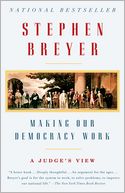
Making Our Democracy Work: A Judge's ViewI believe Stephen Breyer's Making Our Democracy Work is the last lingering book that I got from our library's Tempt-Me shelf last year, before the big ban of the Double Dare.  I liked reading about how one of our Supreme Court Justices thinks the Court should work.  He starts with a background of what the court is and the history of some major cases, but the main thesis of the book is how the courts work with the other sections of government in a pragmatic way.  Pragmatism is one of his key philosophies as a judge, preferable to other baselines such as original intent.

Breyer's view is that in general, courts should look at the presumed intent of Congress when interpreting a law, and apply that to vague or confusing passages.

In this way, voters can use the actual results of a law to decide if they like the way their legislatures are performing.  He gives examples both historical and modern, and uses cases where he ended up on both the dissenting side and the winning side to show the practical effects of various decisions.  He looks particularly hard at some of the worst cases to see how and why the Court went wrong, and what were the effects on its usefulness and public confidence (Dred Scott, Cherokee Trail of Tears, Japanese interment in WWII).  I fell he does a decent job of avoiding personal politics and presenting facts and effects of various judgements.  It's a readable look at our modern court, finishing with some of the post-9/11 decisions about the limits of habeus corpus.

He doesn't completely convince me about pragmatism; he seems to feel any time the court makes a decision that doesn't work out it has failed.  I think that sometimes that just echoes the fact that some laws are failures; the court interpreting them in a way that makes them work jumps boundaries.

Slow Week

I finished a few more books this week, and started even more. My son stole borrowed my NOOK for two days, causing great emotional distress, which is odd considering I'm also reading a large handful of paper books.

This is the meme hosted by Sheila at Book Journey. What I read, what I'm reading, and a peek at what I'll read next, where I check up on my reading patterns for the previous week. Also, at Teach Mentor Texts they do another roundup that concentrates on children's books, which made up the majority of my reading this week.

This week I finished only books, three children books and two grown-up ones.  I also read a few picture books for the Cybils challenge, and wrote up our response to the Early Readers:
I'm showing eleven books on my currently reading list, which really isn't that bad. I do think I need to read more nonfiction, though.
  • Vampire Academy, Richelle Mead. Gift from Librarything Santa, very teen vampire.
  • Spellbound (Books of Elsewhere #2), Jacqueline West. TBR list. Girl tries to save boy.
  • Anna Dressed in Blood, Kendare Blake. Cybils. Ghost-killer rides into a Canadian town.
  • The Brooklyn Nine, Alan Gratz. RML. Stories, so far depressing, connected by baseball. Possibly a baseball.
  • The Trap (Magnificent 12 #2), Michael Grant. RML. I still like the golem best.
  • Abraham Lincoln, Vampire Hunter, Seth Grahame-Green (NOOK).  For my book club. On Friday. Must read soon.
  • Smart But Scattered, Peg Dawson & Richard Guare.  The finish-a-book slot reward slot.  My scattered son and I will take the tests real soon now.
  • The Same Stuff as Stars, Katherine Paterson. Mom isn't coming back.
  • The First Men In the Moon, H.G. Wells.  Back to earth.
  • The End of Racism, Dinesh D'Souza.  The solution is for blacks to buck up and work harder.
  • Honored Enemy, Raymond Feist & William R Forstchen. United against a worse enemy.
What will I read next? I've got a shelf full of Cybils books waiting (many of them almost due back to the library), the last library book left from the beginning of the year, and the reading my library pile. P picked Nerd Camp as our March book club book, so I need to get on that. Also, I gave myself a Shelfari goal to read my age in books before my birthday, but that's going to be tight. Clearly time to concentrate on easy kidlit. On the plus side, I've read some of the books I've been reading the longest, so the icon on the right will keep changing.

Challenges:
  1. Cybils: 36/80.  Almost done with picture books.
  2. Global Reading Challenge: 8/21.  Added Japan.
  3. What's In a Name?: 5/6. Replaced a weak entry with Christmas Angel.
  4. Where Am I Reading?:  12/50. Only need three more this month.
  5. TBR Double Dare.  12. If I count the library book that I forgot I own.
  6. Science Book Challenge: 1.141/3.14159. I need to read more nonfiction.
  7. Reading My Library: Some good ones in this month's pile.
  8. Eclectic Challenge: 2/10.  Romance is done.

Sunday, March 4, 2012

Rebel Flyers: The Girl Who Could Fly

book - the girl who could fly
When I saw Victoria Forester's The Girl Who Could Fly on the shelf during my Reading My Library collection run, it looked familiar.  I thought it was on my TBR list, so I congratulated myself on shooting two birds with one library card, but actually it was familiar because I had ordered it from a school book order some months earlier.  Well, technically it was my kid's order, but I'm fairly sure the hand on the pencil was mine. The fifth grader especially is of the opinion that we have plenty of books already.

So technically, can I move my copy of the book out of my TBR pile and count that? Hmm, ethical challenges for my reading challenges.

Anyway, Forester's book is about kids with superpowers and the government conspiracies against them, so YAY!  Pulling it down a bit was Piper's homespun accent and naive pollyanna-ish demeanor, but as long as the scientists kept messing with the magic kids I kept turning pages.  After a bit of a soggy middle, the final action scenes and split second plot worked really well, and I even enjoyed the happy-ever-after bits.  The door is open to a sequel, and if I convince my older son to try this book he'll probably make sure we find it.  The cover doesn't really appeal to his geeky soul; it's soft and flowing rather than stark and conspiracy-ish.

Also, I'm cranky that I can't identify Piper's home state.  West Virginia? Kentucky mountains? Argh!

Saturday, March 3, 2012

Reconnection: Twin Spica 3

A girl wearing bob cut hair in Japanese high school uniform—consisting of a blue pleated skirt, a blue blouse with a sailor-style collar and neckerchief, and an orange hooded sweatshirt—stands on a backdrop of exploding fireworks. Two glowing spheres linked by a glowing ring hover between her hands. The text "Yaginuma Kou Presents" and "Twin Spica Volume:01", and their Japanese versions, are written to her left.Kids in boarding schools are a strong genre, but Kou Yaginuma's Twin Spica puts a distinct spin -- the kids in its boarding school are heading for outer space.  Reading it gives me a chance to practice my manga-fu, which is still pitiably weak.  So far I really like the odd numbers of this series; #2 left me a bit cold, but #3 kept me interested and left me wanting the next, which of course I can't have for months because of that silly TBR Dare.  Humph.

Anyway, this one delved more deeply into the relationships between the students, especially the aloof Marika.  I still sometimes have trouble telling people apart, so I like it when characters are super short or always wear black or have some other cartoonishly simple identifier, but I think I'm slowly getting better at this, as well as reading backwards from line to line (I can turn pages correctly, but my eyes like to start at the left of each line, which makes many conversations skip oddly).  I'll go back to these once I'm ordering from the library again. My seventh grader has walked away; he gave up when he realized that the school itself is still on the ground and these kids are only *training* to be astronauts.

Friday, March 2, 2012

Rational Love: Christmas Angel


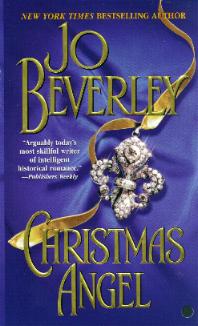
If two people make a sound and reasonable decision to unite together in a plan of matrimony, secure in the knowledge that they can be good friends and helpmeets without going near that icky thing called love, and those two people are in a romance novel, can anyone predict the ending?  Jo Beverley's Christmas Angel doesn't pretend that the suspense lies in the HEA, or even in the skating rink smooth path to that destination, but rests the story in the slow unfolding of both Judith and Leander's trust in themselves. Luckily they (and we) are easily distracted from the pip-squeak forces pulling them apart -- how embarrassing to be the first one to admit that you've accidentally fallen in love with your spouse despite all promises?

So a lot of this book dashes back and forth from the shadowy menaces of both their families.  Her side is much less talked about but ultimately more sinister, while his side is a giant shadow form cast by a tiny and cute little mammal. This is a cosy story about two adults in an imaginary world who build a new family together despite having precious little experience in how to do that.  It's one of Beverley's Rogue books, about a group of fifteen or so very close friends and the women they marry.  I find that conceit charmingly implausible -- who has fifteen best friends? -- but it gives a nice umbrella to her wish to tie all these books together.

I do think the title is silly; yes, Christmas happens, but it's not that important to the story except as an excuse to make Leander try Judith's homemade wine. "The Poet's Bride" or "The Diplomat's Seduction" or "The Bereaved Angel" would all have at least something to do with the story.

Thursday, March 1, 2012

Princess to Queen: Girl of Fire and Thorns

The Girl of Fire and Thorns
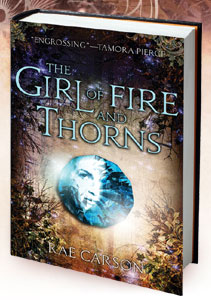
Somehow I have four Cybils Fantasy & Science Fiction (YA) finalists out from the library at the same time (and a fifth that I own also in waiting).  So I'd better start concentrating on them, starting with the one on my NOOK, Rae Carson's The Girl of Fire and Thorns.  (I do love my library's ebooks.)

Carson does a great job of portraying religion, even a religion possibly linked to technology (there are hints that the people arrived on their planet, like on Pern).  Some aspects are tangible; Elisa really does have a Godstone in her navel, and it responds to her surroundings and her prayers.  But various groups have vastly different interpretations of what God wants; different versions of the sacred texts are passionately defended.  Several times the point is made that many people seem to have very firm ideas on what God wants or dislikes, while Elisa herself with her living link can't fathom what her purpose or goals should be. I should do a list of SF that handles religion well; this book, Sharon Shinn's Samaria books, Peter Dickinson's Blue Hawk, any others?

Elisa also grows and changes throughout the book; at the start she despises herself for her lack of ambition and assertiveness, but slowly she learns to act in accordance with her values.  She saves the life of her prince, she searches for the information others try to hide, and she refuses to show fear before her enemies.  Maybe I'll now try to get the hard copy for X to read; I bet he'd love it but the book disappears from my NOOK tomorrow.

Speaking of my NOOK, I went shopping at B&N last weekend and drooled over the forbidden fruit (see TBR Dare on the challenges link). I went so far as to offer to buy X a NOOK for himself just because I had a really good coupon.  X, annoyed that I was talking to him when he was trying to read a book, told me it was unnecessary.  Well, guess who just discovered that the library has Dresden Chronicle ebooks available immediately (unlike the paper versions, which have long hold lists)? Guess who has STOLEN MY NOOK to read them.  Humph.  Now guess who's coupon expired yesterday?  Guess who will have to wait for his birthday now?