Friday, May 6, 2011

Cherry Blossom Book: The Housekeeper and the Professor

The Housekeeper and the Professor: A NovelBookNAround reviewed The Housekeeper and the Professorlast January, but apparently a lot of people were influenced by her enthusiasm, so my library queue took until late March to disgorge it for me.  Yoko Ogawa's story is told exclusively by the housekeeper, a pragmatic woman who has been working to support herself and her son since she was seventeen.  She seems lonely, but unwilling to waste time on her own emotions when she barely has time for work and her family as it is.  But she still has the compassion to befriend the professor, a man with a permanent brain injury that prevents him from remembering anything new.  His current memory only lasts 80 minutes; each morning he wakes up with no memories of his life since the accident that damaged his mind.

The story concentrations on actions rather than emotions, letting the reader understand from the movement what the characters are feeling.  This leaves the emotions somewhat abstract, strongly felt but not verbalized, more a poem than a paragraph.  The relationships between the woman, the man, and the boy (her son) are based on immediate events -- love of baseball, the math facts and ideas the professor eagerly shares, the routines the housekeeper sets up for them.

The book is translated by Stephen Snyder, and I think I'll start looking at translators more closely. So far I really like the style of almost every Japanese-translated book I've read, and I'm not sure if what I like is the translation style or a Japanese style of writing.  It's a sparse style, where a deceptive simplicity allows a beautiful and powerful story to develop.  The picture of a cherry tree works well as the cover of this book with the delicacy and stunning loveliness of a blossom. A

Thursday, May 5, 2011

Small Step Forward, Giant Leap Back

Renton Library

Last week my kids spent with their father and I took a trip to visit my dad.  Which meant extra reading but less reviewing, which means not many books or CD's went back to the library.  Librarians had no such issues, which means they had more books ready for me when I came back. 

Today the hold shelves delivered:
  • Strange Blood
  • Margaret Sanger: Pioneer of the Future
  • Aunt Dimity and the Family Tree
  • Dark Mirror
My older son picked Ender's Shadow for our family read for May, which reminded him to check for new Card graphic novels, which for some reason got checked out on my card.  N found a new movie, but since we already have the complete collection of Elephant and Piggie books out for him, he wisely avoided new books. P was convinced to check out Jon Scieszka's Funny Business, because he agreed that short stories matched his jet-lagged reading abilities this week.

We also got six new CD's for the car, leading to a tantrum on my part when the kids behaved obnoxiously during West Side Story.  I think I will only get classical instrument pieces next week.

That brings me to 87 items out on my card, not counting the ebook.  That is more than 79.  I will soon hit my library's insanely high limit of 100 items. Marg at The Adventures of an Intrepid Reader and Clare from The Captive Reader take turns with the linky for Library Loot. That's where all us library lovers go to compare our hauls for the week.

Strange History: Thendara House

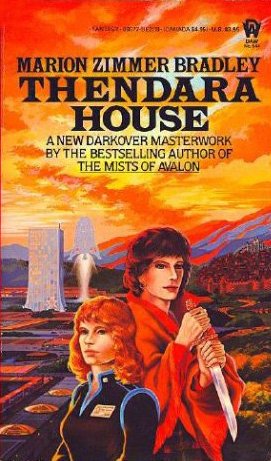
Thendara House (Darkover Series)Somehow I missed most of the Marion Zimmer Bradley Darkover books, which I associate with the seventies. Actually a lot of them came out in my teen age, when I should have been perfectly timed for them, but I didn't get hooked.  But when Jo Walton reread some for her tor.com re-read series, I became intrigued enough to pick one up second hand, and then eventually to read it.


Thendara House (Darkover: Renunciates Trilogy, Bk. 2) feels a bit like a thought experiment, and a lot of it feels very dated.  It contrasts a Darkover woman trying to live and work in the modern Earth society and a Terran citizen trying to achieve status in a rigorous Darkover sisterhood.  The back copy describes it as "two cultures, one male-dominated, one egalitarian" which is true although in the book it is the Terran society that seems male-dominated, although only because the Terran woman immerses herself in an all-female enclave, so that it is egalitarian as a matter of course.  The Terrans pride themselves on their equality, which seems quaint as Bradley shows them as incapable of grasping the concept of a woman keeping her last name after marriage.  The Terrans do not appear in a favorable light, being too busy making assumptions to ever see anyone clearly.  But the Renunciate society feels too contrived to be convincing.

Most of the time is spent deep inside the heads of Jaelle and Magda as they negotiate their new environments.  They often have wide emotional swerves, many of which they recognize but cannot control.  It's an interesting look on what defines femininity and personal responsibility, if a bit claustrophobic at times.  I'm left with an interest in more books of the series.  B+

Wednesday, May 4, 2011

Battle For Skandia and Icebound Land

Go Vikings! I mean Skandians. My sixth grader is chugging through the Ranger Apprentice series, and I'm tagging along for the ride.  Books Three and Four: The Icebound Land and The Battle for Skandia have John Flanagan again providing swift excitement, good camaraderie, and even UST! (for the acronym challenged, that's unresolved sexual tension)


 I do find it amusing that these Australian-written books take place over a mock-Europe, with French-types and Viking types and steppes types in roughly the same places.  It seems Great Britain is not an island though, but then my geography isn't the best in real life, let alone in fictional worlds, so don't take my word for it.  It's nice that the separate plot strands come back together; Halt pitches a fit to get himself banished so he can traipse across pseudo-France with Horace, and then catches up with his apprentice in time to be trapped in Viking Land with him.  Meanwhile Will and Evanlyn meet noble and despicable vikings, she learns her life is forfeit if she is recognized, and Will gets addicted to an evil drug so she gets a chance to make decisions and save people.  Whew! The plot tension moves around a bit; we get a bit of worry with the blood feud between the princess and the uberjarl, but conveniently that goes away when it's time to worry about Halt's legal feud with his own king.

The battle scenes do not have the gritty realism of Stirling's Change series; arrows only run out when the plot needs them to, for example.  But all the kids get a chance to be heroic, the bad guys aren't too stupid, and Evanlyn cures Will's drug addiction, which is always a good thing.  I'll keep reading, although I would go at a slower pace if not for my son's single-mindedness. B+

Tuesday, May 3, 2011

Housekeeper With Benefits: The Heir

My sister, who loves me (see Take a Chance challenge), recommended Heir by Grace Burrowes when I asked her for a book I hadn't read before.  To add icing to the cake, she lent me her Kindle to read it on, so I got to try out handheld electronic books as well as the recommended text.  I enjoyed both, but am not going to seek out my own.  Unless of course, said sister gives me an AWESOME birthday present, so that I have my own cosy personal NOOK, complete with library ebooks.

The Kindle was fun to read, and definitely lighter than a book.  I of course carried my bag of books around with me anyway, because what if I wanted to read something else, but when I got stuck icing my shoulder for twenty minutes after physical therapy, I enjoyed the Heir and the lightweight reader too much to want to swap out.  I think most people would find it easy to use from the start; as a klutz it took me a while to figure out how to escape the table of contents, and then later, to find the table of contents again.  The pages felt a bit small but didn't hinder my reading rhythm in the way that large print books do.

The book itself was a fun historical romance.  The characters were fairly modern in their outlook, but not baffled by their society.  In some historical romances, the heroine is SHOCKED to discover that women don't get to vote or win medical scholarships or use birth control (except often Our Heroine has learned this art from her crafty grannie), but in this one they seemed fairly grounded in their time but still comfortable hanging with the present day reader.  The initial set-up was fun (I always like when the main characters meet by accidentally attacking each other, although it helps if the less powerful person wins).  The love scenes were refreshingly believable, and my main complaint was the last quarter of the book, which was silly and unnecessary.  It was the worst kind of plot by misunderstanding, where both make unreasonable and incoherent assumptions and then refuse to mutter a word that would clear everything up.  The occasional appearances of the blackhearted and paper-thin villains actually pulled this part of the book up a bit, which is a sad thing.  My sister and I were very impressed by this first book by Burrowes, although when I went looking for her web page I see that actually it's the pen name for a fairly prolific author, so the first-book mistakes aren't so forgivable after all.  Anyway, very nice story that doesn't stick the landing.  B

Monday, May 2, 2011

Runs in the Family: The Curies

After reading Borrowed Names, I wanted to know more about Irene and Marie Curie.  So I checked the bibliography and ordered up one of the reference books.  The Curies: A Biography of the Most Controversial Family in Science starts with Marie and Pierre Curie and continues with daughter Irene, her husband Frederic Joliot, and daughter Eve.  I think the standard of controversial science families must be rather low, since the main controversy seemed to be that Marie and Irene were both women (!! yes -- it is true!!).  Well, Marie Curie was accused of having an affair with a married man once, and Frederic Joliot became a communist, but then so did most of France (both have affairs and become communist).

Denis Brian does a good job establishing a narrative.  He often has several strands going; he traces the families and childhood of both Marie and Pierre and then later follows both Eve Curie's travels as a journalist and Frederic Joliot's work in France during and after World War II.  Joliot gets more attention than Irene from their marriage onward, which was a bit of a disappointment for me since Irene was my main interest going into the book.  Borrowed Names was about the relationship between Irene and her mother, and this book gave me more of the facts behind the events mentioned in the poems.  I wish there had been a bit more explanation of the actual science, especially for Irene and Frederic, because sometimes that got lost in the descriptions of the arguments between scientists.  But I got a sense of the transition from the work the early Curies did in a shed to the more elaborate work of Irene, and finally the gigantic systems Frederic's late work required.  And the transition from the pure science of the early discovery of radioactivity through wild enthusiasm of its potential for good to the horror of the atomic bomb.

I'm interested in continuing to learn more about the Curies, perhaps with a stronger look at the science behind their work.  B

Flying Means Reading Paperbacks

Each Monday Sheila at Book Journey asks about how the reading week went -- what people read, what they are reading, what they will read. I visited my dad this week, so I had a couple of long plane trips, which helped me finish some crisis library reading. I've also noticed that I now have a huge backlog of books to post; I usually only post a book a day, and I'm about a month behind. Maybe a reading slump will happen soon, and bring me closer to my daily reading.

What did I read?
  • Blackout, Rob Thurman.  I tried a new urban fantasy, and liked it.
  • Secrets of the Demon, Diane Rowland.  Third book about a detective with magic powers.
  • Every Time a Rainbow Dies, Rita Williams Garcia.  Tough book about teens facing tough lives.
  • Frisco's Kid, Suzanne Brockman.  Romance about a crippled army guy and a schoolteacher.
  • Tiassa, Steven Brust.  Next in the Vlad Taltos series.
  • The Glass Harmonica, Louise Marley.  Musicians meeting across time.
  • The Man-Handler, Cairo.  Waste of a good tree.
  • The Folk Keeper, Fanny Billingsley
  • Plain Kate, Erin Bow
What trends do I see? My over extension at the library is heavily driving my reading choices last week and this week.

Right now I'm reading: 
  • Queen's Play, Dorothy Dunnet, my library Nook book, about to disappear
  • Cagebird, Karin Lowachee. Leftover from trip.
  • Tortall and other Lands, Tamora Pierce, library book
  • Betti on the High Wire, Lisa Railsback, for Cybils challenge
  • Territory, Emma Bull (vacation book)
  • Hammered, Elizabeth Bear (vacation book)
  • Bad Prince Charlie, John Moore (vacation book)
  • Interior Life, Katherine Blake (vacation book) 
  • The Rogue's Return, Jo Beverly (vacation book)
  • The Hob's Bargain, Patricia Briggs (vacation book)
  • Flying Solo Ralph Fletcher (borrowed by a kid, now returned)
  • The Secret Duke, Jo Beverly.  Found under my bedside table with a bookmark.
  • How I Met My Countess, Elizabeth Boyle.  Also found.
I'm just poking at the vacation books; mostly I'm reading the top four.  I've got the new Walsh/Sayers on my list, as well as some books due next week. I may have to do some fast reading tomorrow if I can't renew some stuff.  I also think I'll pull out some nonfiction from my TBR piles.

Quick stats on my Challenges:
A-Z: 25/52.  One more down.  But I see some more qualifiers in the pile.
Cybils: 35/76.  One more.  I'm currently reading another though, plus a poetry book.
Michigan: 1/2 Review waiting to be posted.
Once Upon a Time: 8/5.  I'm listing them before reviewing them.
Read Around the World: 7/20.  Half of my books will end up being Ranger's Apprentice books.  I'm signing up for a setting challenge because authors are hard. 
Stream: 3/3.  I found another biography in the references for my next read.
Take a Chance: 3/10. My dad had the Economist's Best of the Year 2010 list, which helps.
20/11: 13/20. Cruising!
What's In a Name?: 4/6.  
Where Am I Reading?: 19/50.  I got to New York and Louisiana.