Showing posts with label SF challenge. Show all posts

Friday, March 18, 2011

Feeling the Experience: Wrap-up of Sci-Fi Experience

The Sci-Fi experience officially ended on February 28th, but since I was behind on my reviews I waited until most of my reactions appeared.  I didn't really change my reading habits at all, but I did pay a bit more attention to what genre I was reading.  Usually I lump fantasy and science fiction together (speculative fiction, if you insist on an acronym), but for those two months I enjoyed noting which of my books were properly science fiction, especially contrasting them with fantasy.


Sometimes the differences aren't fuzzy.  Urban fantasy is rooted in reality, happening within this world.  The Call is magic, so fantasy, although they use credit cards to book air travel.  Alien Tango is science fiction, because the aliens come from space.  Magic users teleport, science types use portals, but the result is the same.  The science is often just magical hand-waving.

Is the difference philosophical? A matter of tone? If so, is it something the author puts in or that I inject because I know what I'm reading...  It's not hard at all for me to put most SF books in one camp or the other (science fiction or fantasy), but a lot of times the best books are the ones that keep a foot in both camps.  My favorite book of the experience was a fantasy book that was partly about the love of science fiction, Jo Walton's Among Others.

In other challenge news, I've got 18/52 books for the A-Z challenge, 22/76 Cybils books, half of the Michigan books (well, one), I've started a book for Take a Chance, have 3/6 for What's in a Name,  and 9/50 states.  I keep repeating states, or reading books where the silly characters trek about without settling anywhere. (I'm looking at you, High King of Montival!)

Saturday, March 5, 2011

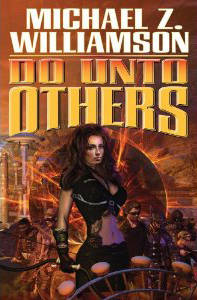
Send Lawyers Guns and Money: Do Unto Others

Some books have themes, some have messages, and sometimes the difference is stark. I'd say that Michael Z Williamson's Do Unto Others has some strong messages (weapon safety is important, professionals do it better, don't trust penny pinchers) but no real theme. What it does have is characters doing their jobs while Williamson shows them at work. And since they work for a galactic security company, that's often fun for me.

This is the second book about Alex's elite team, and I've finally gotten all the players sorted out. They don't spend much time on introspection, other than young Aramis's occasional contemplation of the sexual charms of his employer or any other female type in the vicinity, but their actions manage to define them. I'm actually surprised at how unsophisticated they seem sometimes, but then I have experience with many galactic civilizations and they only know their own. None of them seem to be big readers, other than arms manuals. But the writing is crisp and the people fun, especially Elke (I think that is her on the cover), who always gets the biggest booms. I'll keep picking up Williamson's books, although I admit it's a bit of a guilty pleasure.  B

Friday, March 4, 2011

Feminist Fun: Alien Tango

AT BookcoverGini Koch's science fiction romances have too much fun to take themselves seriously.  Kitty, the protagonist, probably realized that life was too short to stress the small stuff when she first noticed that her name, Katherine Katt, was a poor pun that her parents would pretend never to notice.  This attitude suited her well in the first book, Touched By an Alien, when Koch delighted in throwing ridiculous twists her way, and Kitty handled them with aplomb.

In the second book, Alien Tango, Kitty continues to enjoy herself on her own terms, which I find a strong and feminist place to be.  She likes her big purse, and can find stuff in it.  She knows some martial arts, but prefers to let the people with superpowers fight it out against the big trucks.  She enjoys great sex, but doesn't expect it to always lead to marriage.  True love is great, but if she's not treated well, she'll walk out.  Emotional cluelessness is not a male preserve, and neither are blinding flashes of brilliance.  And confidence in them.

This was a great book to read on lines at Disneyland, because the tone is light, there is something happening every few pages, and I'm not going to be tempted to share it with my kids (see the "great sex" reference above).  Although there are lots of complications, I didn't have to concentrate hard; it was easy to slide back in whenever I pulled it out of my bag.  And now I will always associate it with Space Mountain.

Tuesday, January 25, 2011

The World is Wired: Brain Jack

Another Cybils book!  Although I'm quite pleased at how hard it can be to get my hands on these things.  I was originally going to read The Call, but it's been confiscated by first the 6th grader and now the 4rth grader.
BrainjackI fell back on a YA title, Brian Falkner's Brain Jack.  We follow Sam, a gifted teenage computer programmer who knows how to hack the world's biggest computers.  He's not malicious, although a little theft doesn't bother him, but he hates the idea of finding places on the 'net he can't go.  And he's very pleased with his latest technology toy -- a neuro, the electronic beanie that lets him connect directly to his computer with his brain instead of a clumsy keyboard or mouse. But if brains can connect to the 'net, what can connect to his brain? DUH duh DUH.

Sam doesn't have much depth, but he's usually too busy infiltrating secret fortresses or running like crazy from people annoyed at said infiltration to worry about it.  His friends are even thinner, but since some of them don't make it, perhaps that's just as well.  I had to swallow hard at some of the descriptions of programming, which often took a metaphor and then rode it kicking and screaming into the hills, but once I got over it the ride was exciting and swift.  The ending seemed unexpectedly ambiguous; (SPOILER) they spent the last bit of the book fighting against control by a sentient web but did not succeed in stopping one. And I thought the magic hand wave that saved some key players cheated a bit. I'm going to offer this to my 6th grader and see what he thinks. B

PS.  He thinks it was worth reading in a day, so that's a thumbs up.

Thursday, May 27, 2010

Suspenseful Dissertation: Genesis


I love the premise of Bernard Beckett's Genesis almost as much as I enjoyed the book. Anaximander delivers her graduate defense to a panel of stern and probing judges, which a few breaks for drinks and reflexion. Her defense covers a crucial period in her futuristic world's development, when a man and a self-learning robot were forced together to see if the robot would develop more fully. She is charting the man's possible motivations and influences, and even presents a short film illustrating her conclusions.

Charlie Stross wrote a book that also dealt with robot motivations and stuff, although in his book the robot is the main character, and the Hugo-nominated book is very annoying, with a lot of time spent having the robot grow bigger boobs. This book looks at the nature of consciousness and humanity in a more nuanced way, observing the lonely man's increased reliance on the robot from the distance of an academic report, but with the huge emotional importance that a dissertation has on the writer. Failing to convince here has huge personal implications, while the subject under study had big societal importance, and the ideas presented have universal interest. I'm making it sound dry, but it's fresh, gripping, and short. A-

Tuesday, May 18, 2010

Space Viking: Aristocrats in Orbit

H. Beam Piper's Space Viking has the rewards and flaws of classic science fiction. The characters and writing are bold and confident, sure of themselves and the value of their story. The women are even flatter than the men, and mainly stand around ministering to the sick or adoring the men. The politics are pure Campbell-era, with strong men changing history, either allowing the degenerate masses to despoil civilization or rising above and forcing society to stay on the correct track.

The best part of this slim tale is the toying with conventions. The early chapters set up the worlds of raiding planets (the Vikings, with planets named after swords) and raid-ees, either failed civilizations or degenerate ones. The Bad Guy is insanely evil, and he shows up at our hero's wedding and shoots the bride. Revenge time! Hero buys a ship and goes out into the universe searching for bad guy. Then the well-traveled path takes an interesting turn; hero becomes all wrapped up in establishing a safe base with economic trading partners and a well-organized trading system, and he can't really be bothered to stalk around the universe like a two-legged Ahab. The silly political systems are interesting in an archaeological kind of way, but the arc of healing from loss rings true. B-.

Thursday, April 22, 2010

Icky Action: The Prisoner


Dang nab it, I forgot it was Wednesday. I almost started my K book just now, but remembered my 8AM meeting. I'll just be late.

Instead I'll mention this P book I read. It also starts with a consonant. The Prisoner, by Carlos J. Cortes, was mentioned by Jo Walton as a nominee for the Philip K Dick award, a prize for a science fiction paperback. (It didn't win; I just checked.) I admit, it wasn't my cup of tea, being a thriller more concerned with action, then ideas, and finally characters. The action involved a daring prison break and long slogs through the sewers of Washington DC, the ideas involved freezing human bodies alive, either to await medical treatment (for the rich) or to conveniently serve a prison sentence. Giant corporations run the "ice boxes" and some of the people heading these corporations are Not Nice. But the corporations are now controlling the government...

The bad guys were bad, and stupid, while the good guys were good, and not all that bright, honestly. The sewers were very accurately described, but my main reaction was "ick." I mean, it was awful for the characters to walk through them, but it was awful for me to have to read about it as well. There was action-y action, with assassins and runs through the city (above ground, a few times) and double-crosses, and two characters who fell in love because, well, I'm not sure, maybe there was something in the water in the sewer. Ew. Anyway, I finished it, which means it has something going for it considering how uncomfortable much of the action made me, but I can see why it didn't win. C+

Two minor annoyances for me: one character dies before we meet him; he doesn't survive the defrosting from prison. His friends are sad, and at the end they demand that he get the Medal of Honor. But he and his team all had the same risks; the survivors then had to run through a lot more dangers in the course of the book. I don't think dying is the main criteria of the Medal, and I don't think grieving friends is a criteria either. It just seemed to cheapen things.

The second annoyance is pathetic and has nothing to do with the book -- I'm vaguely trying to mark when I read a book by someone who isn't white (my PoC "person of color") tag, but sometimes I have no idea. It turns out I don't really understand the term Hispanic, and the internet is not helpful (who knew?). I hate having lists and not knowing how to manage them.

Saturday, March 6, 2010

Ender's Teen Years: Ender in Exile


Our book club recently read Ender's Game, by Orson Scott Card. Card is a famous SF writer who also likes to write about writing; he's talked about where he gets his ideas. His first idea for Ender actually became Speaker for the Dead, the sequel, but in order to understand his main character he started wondering about where he came from, and that wondering became the Hugo and Nebula winning Ender's Game. (The Hugo and Nebula are SF's big prizes, awarded by fans and writers respectively.) Then he went on to write Speaker for the Dead, which also won both prizes. But there is a long gap between the two stories. I highly recommend both books, and so does my son (well, he mostly liked the first one, the second one has more mature themes about life and death and stuff).

Card eventually went back to Ender, writing later books and going back to the beginning with a parallel story about other characters in the story. None of these books were as good as the first, and I eventually dropped out. But my son is a completist, so he read his way through all of them, and when I saw Ender in Exile, the book that bridges the main events between the first two, I decided to pick it up.

The story of Ender's life between Ender's Game and Speaker for the Dead fills in some of changes between the boy and the man, and the beginning of human expansion into space. Card's writing has settled down into a fairly talky rhythm, with a deep understanding of the emotional twists of his characters but a tell-not-show habit of explicitly detailing them for the reader. His dialogue sounds hilarious to me, to the point where I'd love to listen to him talk with people to see if he or anyone else really talks like that. But only when people are serious. Maybe I just have no idea how to have a serious conversation.

But the most fun for me was Card's wild family-building schemes, which reminded me of Heinlein. The problem of a skewed sex ratio was fixed by a lottery because everyone knows (at least everyone in these books -- several characters mention this as a fact) that only permanent monogamous families preserve a decent society. No one questions this, or wonders if that lottery thing will make for solid families. The scene where a woman makes a pass at a man because she doesn't like her husband, and the man refuses her because their society needs healthy marriages just seemed to miss so many assumptions that my head was spinning. It's just an aside in the novel, but has me still gobsmacked a week later.

The story itself was fun -- not as powerful as the first two Ender books, but it didn't leave me wishing it hadn't been written (like the 3rd and 4rth). It did a better job of changing things than the other series in Ender's world (the Bean stuff) because it doesn't try to undo important things. Well, it explains why Ender's parents were so dumb; it's because their kids never understood them. I like that explanation. B

Sunday, February 21, 2010

Gruesome Imagination: Unwind


Neal Shusterman's Unwind tells a gruesome tale of a society addicted to a supply of human spare parts. Medical technology allows safe transplants of eyes, organs, even limbs to replace broken or diseased originals. And the new ones come from teenagers whose parents have chosen to "unwind" their kids, usually because of the trouble the children have been getting into. Or because they are orphans, or otherwise unwanted.

Connor and Risa meet up when they go on the run, and they both have to learn to cope for themselves and learn how to disappear and find help from people appalled by the situation. The first part of the book is more about their personal situation, with Connor especially finally learning to control some of the impulsive behavior that drove his parents to unwind him. Shusterman also looks at how the parents' decide this, echoing and amplifying the feeling most parents feel at least momentarily during their offspring's more trying episodes. It's a true example of science fiction; taking a thought about "what if" and "if this goes on" and running with it to see how it plays out, using real people and solid motivations. It's not a prediction, but it is an exciting and suspenseful story.

Oh, for the squeamish, it's the ideas that are gruesome; we don't see a lot of gore and such. B+

Tuesday, February 2, 2010

Boys are Unpleasant: The Knife of Never Letting Go


Patrick Ness's The Knife of Never Letting Go literally puts you in the head of a fourteen year old boy who has been raised by a village of very unpleasant men. The result is, um, unpleasant. I spent the first half of the book looking at my eleven year old son out of the corner of my eye, wondering if he was about to erupt into despicableness. That Why Gender Matters book has made me deeply suspicious of the immature male.

Later into the book I found the action interesting enough to try to overlook my distaste for the viewpoint character. Yes, he was dumb as a post, and self-justifying, and obnoxious, but he lived during interesting times. He had been raised by monsters (although his immediate family only posed as monsters so they could stay and raise him). And maybe if I had cared more about him, it would have been harder to accept the troubles and horrors he went through. Although some of them were entirely self-inflicted, the consequences were still awful for a child. It makes me hesitate about giving my boy a knife before sending him off alone across the world to escape my horrible neighbors. I shall make a mental note not to get into a situation that would require it.

The ending is a deliberate shocker, reminding me that this is the first book in a series. I'm not in a hurry to get the second, but I'll probably read it eventually. A combination of a gripping read with a repelling voice = B.

Monday, February 1, 2010

Knowing They're Foreign: When the Tide Rises


Well, I accidentally got a bit ahead on this series, so I went back to find the one I missed. David Drake's When the Tide Rises continues to deliver on its promises, as do most of the books in the RCN series. There is action, there is political intrigue (based on actually history, this time in South America in the 1800s), there is friendship and marksmanship and skilled professionals and honor and fools and all the fun stuff I like in space opera.

Reading these books backwards highlighted the character development of the main characters. There isn't much, and it's easy to miss, but they are slowly growing and learning about themselves and their friends. Lots of fun, but not the sort of book that haunts your thought afterward. B.

Sunday, December 20, 2009

Fire Dancer Flickers


The book Fire Dancer by Ann Maxwell reminds me of Andre Norton and other SF pocket books I read in the 80s that already felt as if they were decades old. The gender roles seem steeped in traditional mores with a seasoning of sixties free thinking. It's hard for me to tell if the author put this in, or if I just projected because the font and pages felt so familiar to me, with a sexy woman on the cover and a powerful man backing her up.

A lot of science fiction ideas flew about -- a world destroyed by an expanding sun, a world based on gambling where anything goes as long as you have the license, slavery enforced by high technology, good guys with a sense of fairness and bad guys without, sex as a weapon (but only off stage), a categorization of different life forms, including sentient plants and rocks, and a galactic history including lost super races. All that is fun, as are the main characters, bonded together by need and by the loss of their home world. Everything worked as long as you didn't look too hard, and nothing in the text invited close scrutiny.

A fun read, and if I see the sequels in a used book store I'll pick them up, but I won't go looking. B-.

This is book #2 for my SF challenge; 1.14159... more to go.

Friday, December 11, 2009

In the Stormy Red Sky: Horatio Style Space Opera


I'm signing up for another challenge, the Sci-Fi Reading Challenge (Syfy?) from Stage and Canvas. I'm fairly sure I read enough SF to fulfill this accidentally, but if not August is a good time to frantically catch up. The challenge is to read either 3.14 or 8 SF books by August 8, 2010, and I'm aiming for the 8. I'm not sure why 8, other than that cubes are always lovely. 9.86 is the square of pi, so that seems like a reasonable higher goal. Am I super qualified for this challenge or what? Speaking of which, in many ways Dec. 11th is the birthday of science fiction fandom, so this is a very appropriate day for me to start this challenge. Anyway, here is my first qualifying book:

David Drake writes military SF (mostly), usually basing his books on historical events but placing them in his space-faring navy. He even tells you which events he's cribbing for his story, so now I have a very rudimentary knowledge of what happened in the Mediterranean basin around 214 BC. Drake does different things, but In the Stormy Red Sky is part of his RCN stories, with spaceships that read like the line ships of Horatio Hornblower stories and a RCN with many of the trappings of the British navy as well. That is all in fun, and it means I don't even have to pretend to pay attention to the technical details and war tactics bits, just as I don't in the Hornblower stories.

I do find it a bit strange that I like military space fiction so much, given how uninterested I am in the details the authors are usually so proud of. I gather some readers actually worry about whether it makes sense. Wow. The space travel uses a multi-dimensional hyperspace kind of handwavium, with sail things to move from one universe to the next, so it's science fiction but also harks back to the great days of sail. Computer technology and weapons have also advanced a bit, but human nature stays the same.

Anyway, I'm just here to watch the characters jump about, and Drake's characters tend to do a lot of jumping. I think I skipped one or two books in the series, but the character arc here is slow; the characters are fairly static with enough hints of growth to keep me interested. Daniel is the amorous super captain, and Adele is the sterile super-librarian whose computer and pistol skills tend to save the day while the captain's plans save the world. This one seems to be more about Adele and her understanding that the ship crew is her family. Well, it's also about a lot of sailing about and shooting things, and tricking people, and that sort of good clean fun, but that is pretty standard for the genre. What is different between the start and end of the book is Adele's understanding of her emotional limits, which are a bit broader by the end. B